The first agentic OS for Quantum R&D teams is here

Own the future

Publications
Final main usecase proton transfer

How AgenticOS coordinates specialist scientific agents to build, test, and trace a quantum experiment

Case Studies

Read the paper accepted at NeurIPS 2026 workshop.
 

Proton transfer is one of the most fundamental processes in chemistry, and it underlies acid-base reactions. The Zundel cation, H₅O₂⁺, is a compact model of it [1]: two water molecules share one extra proton. The proton can sit close to either water, like a ball resting in one of two valleys, and moving it from one valley to the other means pushing it over the hill between them. The height of that hill, the energy barrier, controls how fast the transfer happens.
We gave the same task to ten standalone AI runs and to AgenticOS. Every run produced working code, but they did not perform the same experiment. Four runs violated explicit instruction to keep all the electrons. Others changed the molecular geometry or followed a different proton-transfer path.

AgenticOS fixed the scientific setup before implementation and tested the code against it. The workflow reproduced the expected two-valley curve. Its quantum method, sample-based quantum diagonalization (SQD) [2], gave a barrier of 554.8 meV, compared with the 574.3 meV FCI reference, a difference of 3.4% for the model studied.


The Input

Every run received the same task: calculate how the energy changes as a proton moves between two water molecules.

The oxygen atoms had to remain 2.9 Å apart, all 20 electrons had to be included, and each method had to be compared with the same FCI reference.


How Does AgenticOS Prevent Mistakes?

Figure 01
Figure 1. The live AgenticOS project graph, taken from the actual project record. Each node is a bounded team of scientific agents that produces reviewable artifacts before downstream work begins.

AgenticOS divided the work into reviewed steps. Each step saved its inputs, results, tests, and decisions before the next step began.

When a check failed, the work returned to the step that caused the problem. A human researcher reviewed the important decisions.

How AgenticOS kept the study on track

AgenticOS fixed the number of electrons, the shape of the molecule, the proton's path, and the comparison method before the calculation began. It checked these details again as the work progressed.

Three checks kept the experiment on track.

- Fix the setup: The electron count, molecular geometry, and target quantity were written into the configuration and tests.

- Check the tests: Critic agents looked for tests that passed without checking the right scientific property.

- Keep a record: AgenticOS saved the structures, settings, samples, test results, and review decisions.


What Went Wrong in the Standalone Runs?

The ten standalone runs produced different energy curves because they did not preserve the same experiment. Some left out required electrons, while others changed the geometry or proton path.

Figure 02
Figure 2. Five Sonnet and five Opus runs compared with the same FCI reference from the AgenticOS run.

- Reference: The dashed curve uses the fixed 12-point AgenticOS protocol with 15 orbitals, 20 electrons, no frozen core, and a 2.9 Å O-O distance.
- Standalone runs: The curves come from different experimental setups, even though every run received the same task.

A convincing curve is useful only when the experiment behind it is clear and consistent. AgenticOS was the only workflow that kept the agreed setup from start to finish.

Why the standalone results disagreed

Some runs left out electrons. Others moved the atoms differently. They produced curves, but they were not running the same experiment.

Failure mode

Without AgenticOS

With AgenticOS

Electronic space

4 of 10 agents used a frozen-core approximation, excluding core electrons despite the explicit instruction to use all 20 electrons

15 orbitals, 20 electrons, with frozen core disabled

Geometry path

Some agents used shortcuts that could not resolve the intended double well, including frozen water geometries and interpolated, non-minimized scan points; others followed a different proton-transfer path

Fixed 2.9 Å O-O distance, an on-axis proton coordinate, and outer hydrogens re-relaxed at every scan point

Trust in the result

Each five-agent baseline set produced five different potential-energy curves; several profiles were visibly irregular

One locked protocol, with configuration, scan data, tests, diagnostics, and caveats saved for review


What Does the AgenticOS Run Show?

All five methods calculated the same proton-transfer curve. They differed in how they treated the motion of the electrons. FCI was the reference for this model.

- PBE: 83 meV. Its approximate treatment produced a barrier that was too low.

- Hartree-Fock: 785 meV. It used one electronic pattern and missed part of how the electrons move together.

- CCSD: 606 meV. It included more electron interactions and came closer to FCI.

- FCI: 574.3 meV. It provided the reference answer for the chosen model.

- Quantum method (SQD): 554.8 meV. It used quantum sampling followed by a classical calculation and gave the closest result to FCI.

Figure 04
Figure 3. Shared proton transfer scan and fitted barriers in meV. Dashed halves are mirrored.
The quantum method, SQD, came close to the reference result compared to the classical methods tested.

SQD put the height of the energy hill at 554.8 meV. The reference result was 574.3 meV, a difference of 3.4%.

The methods differ because each captures electron motion with a different level of detail. SQD uses a quantum circuit to sample the electron configurations most likely to matter. A classical solver then calculates the energy from that smaller set. The full model contains more than nine million possible electron configurations. SQD focused on a smaller set and produced the closest barrier to the FCI reference.


Conclusion and Outlook

Reliable computational chemistry depends on keeping the scientific question consistent from setup through analysis. In this study, the standalone runs produced working code, but several changed the electron count, molecular geometry, or proton-transfer path. Their results therefore could not be compared directly. 
AgenticOS maintained one shared experimental setup across the calculation. It also kept the inputs, tests, intermediate results, and review decisions available for inspection. For research teams, the value reaches beyond one calculation. AgenticOS can coordinate work that crosses scientific literature, molecular modeling, software development, and validation while keeping important assumptions visible. Researchers remain responsible for the scientific choices and interpretation. 

We hope this example encourages other scientists to bring their own difficult, multi-step research questions to AgenticOS. The platform can help organize the investigation, test competing approaches, uncover hidden inconsistencies, and produce results that are easier to review and build upon.

Footnotes

[1] M. Schröder, F. Gatti, D. Lauvergnat, H.-D. Meyer, and O. Vendrell. The coupling of the hydrated proton to its first solvation shell. Nature Communications 13, 6170 (2022). https://doi.org/10.1038/s41467-022-33650-w

[2] J. Robledo-Moreno et al. Chemistry beyond the scale of exact diagonalization on a quantum-centric supercomputer. Science Advances 11(25), 2025. https://doi.org/10.1126/sciadv.adu9991

Final usecase2 optimization

Haiqu AgenticOS helps design novel quantum optimization algorithm scheme

Case Studies

Haiqu AgenticOS helped turn a research question into a tested algorithm that combines Digitized Cyclic Annealing with classical population-based search, producing better optimization results under the same sampling budget 

Better optimization methods could help industries use energy, infrastructure, and computing resources more effectively. Applications range from routing delivery fleets and scheduling factories to designing communication networks and balancing power grids. Quantum computing may offer new ways to explore these large solution spaces. However, turning that potential into practical improvements requires algorithms that can operate within real sampling and hardware constraints.


Further adoption of quantum optimization methods also depends on how these approaches fit into typical end-to-end optimization workflows. Classical solvers often run multiple searches and let them exchange promising solutions. Could quantum searches benefit from the same strategy? Could a discovery made by one optimizer help others explore more effectively, without increasing the quantum sampling budget?


We used Haiqu AgenticOS to investigate this question by combining our recently proposed Digitized Cyclic Annealing algorithm with classical Population-Based Search. 

Starting from a published algorithm and an existing implementation, AgenticOS helped develop the extension, compare coordination strategies, and audit the experiments under the researcher’s direction.

On a simulated 100-spin benchmark, coordination reduced the remaining distance from the known optimum by approximately 60% compared with independent searches under the same sampling budget. This initial result provides a direction for further research and offers a concrete example of how AgenticOS helps scientists turn ideas for quantum applications into testable algorithms and evidence.


1. Why Investigate Coordinated Quantum Optimization?

Many real decisions come down to choosing the best option from an enormous number of possibilities: which devices should relay network traffic, which route a delivery fleet should take, or how jobs should be scheduled. Each choice breaks into yes-or-no decisions, and the number of combinations doubles with every extra decision, so even a fast computer cannot try them all. Problems like these are called combinatorial optimization problems [2]. Choosing the smallest set of devices that keeps a wireless sensor network connected, known as a virtual backbone, is one example [3]. Practical solvers settle for good answers, and they often get stuck on answers that look best locally but are not the best overall.

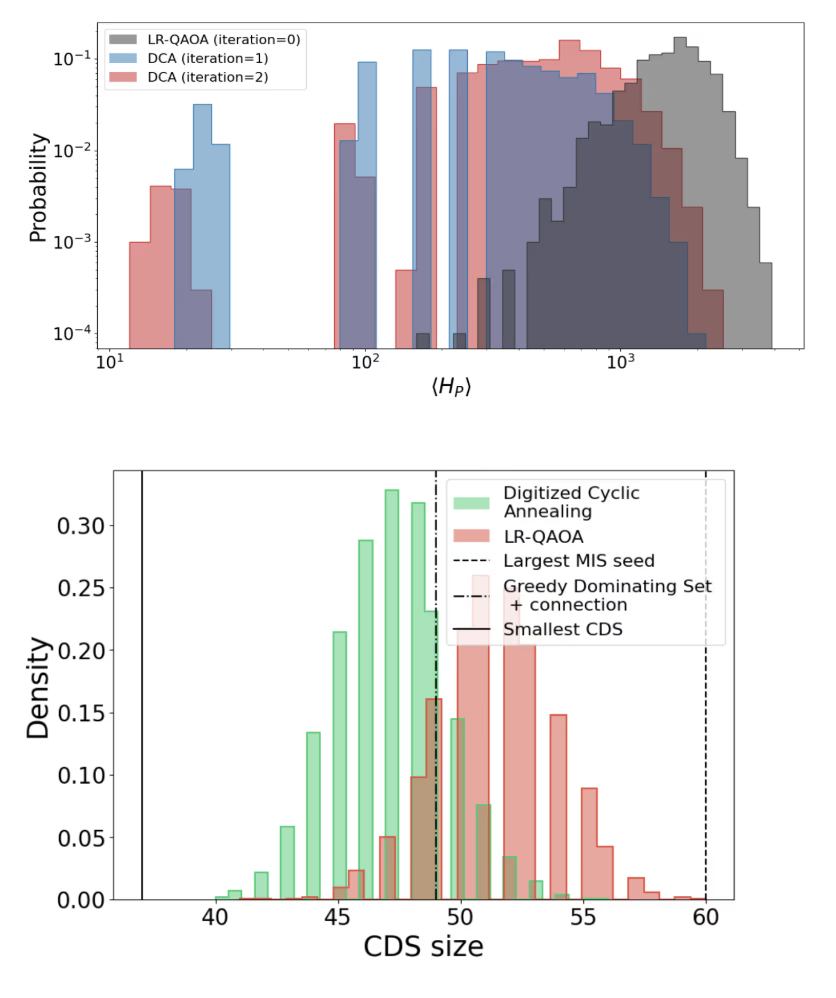
Haiqu’s Digitized Cyclic Annealing (DCA) is a quantum algorithm for problems of this kind, and its original paper addresses virtual backbone problems [1]. DCA searches by running a quantum circuit many times, and today’s hardware allows only a limited number of runs, called shots. That raises a practical question: given a fixed number of shots, is it better to spend them on one long search or to split them across several copies of the optimizer that run side by side?

The rest of this blog explains how AgenticOS helped the researcher turn that question into an experiment comparing independent searches with several ways of sharing discoveries.

DCA in Brief: How Does Each Search Work?

A candidate solution is a bitstring: a sequence of 0s and 1s representing decisions. Its quality is measured by a cost, often called energy. Lower is better; the lowest-energy solution is called the ground state, and its energy is the ground-state energy [4].

Haiqu’s Digitized Cyclic Annealing (DCA) [1] translates cyclic annealing [5] into a sequence of quantum gates. Its basic search loop is:


  • Choose a reference solution to guide the search.
  • Run a quantum circuit that uses this reference to explore candidate solutions.
  • Measure and score the candidates. Each circuit execution produces one sample, called a shot.
  • Keep the better solution as the reference for the next cycle.

Repeated cycles aim to find progressively lower-cost solutions. Every replica in this study uses the same underlying DCA circuit. Coordination changes how replicas choose their next reference: they can use their own discoveries or adopt solutions found by others.


2. What Was the Input?

We provided AgenticOS with a concrete starting point:


  1. The DCA paper [1] and related literature, describing the algorithm and its scientific foundations.
  2. An existing single-search implementation, providing a baseline to reproduce and extend.
  3. A research question: how should multiple DCA searches share discoveries, and would coordination improve their results under a fixed sampling budget?


The initial plan covered a single search, several independent searches, and searches that could adopt the best solution found by the group. Each copy, called a replica, would run the same underlying DCA circuit. The investigation would change how replicas exchanged candidate solutions between cycles.

The task for AgenticOS: build a reusable multi-replica implementation, preserve the original DCA behavior, and design controlled experiments to compare independent and coordinated searches.

This required connecting the literature to an executable research plan: defining the communication rules, implementing them consistently, and deciding how to measure their effects. The researcher reviewed the proposed directions and steered which methods and experiments to pursue.


3. How Did AgenticOS Turn the Idea into a Trustworthy Experiment?

AgenticOS organized the investigation into connected research and engineering modules. Outputs from literature analysis informed the prototype design; the implementation then fed into experiments and further revisions. The researcher reviewed the proposed directions and steered the work throughout.

Figure 01
Figure 1. Live AgenticOS project graph for the multi-replica DCA study. Each node is a group of AI agents that completes one task and returns its output for human review.

Define what the experiment must establish.
The research and design modules translated the question into concrete requirements: preserve the underlying DCA algorithm, support different communication rules, and compare their effects under equal sampling budgets. The investigation needed to distinguish improvements caused by coordination from those caused by additional samples or changes to the quantum circuit.

Build from a reproduced baseline.
AgenticOS reproduced the existing single-search implementation before extending it into a population of replicas. It developed a reusable architecture in which the communication policy could change while the underlying DCA search remained consistent. Architecture reviews examined assumptions and data flows, including how random sampling would operate across replicas.

The framework supported different population sizes, shot allocations, and coordination policies. A matrix product state simulation path, which represents quantum states compactly when their entanglement allows it, enabled experiments with 100 spins.

Design controlled comparisons.
Experiment modules developed comparisons between independent searches and communicating populations. They tracked sampling budgets, kept results from different methods separate, and supported repeated runs with different random seeds. Diagnostics also examined population diversity, helping the researcher investigate whether sharing spread useful discoveries or concentrated the searches too early.

Audit, correct, and check again.
Verification continued as the implementation evolved. The project records describe audits that caught incorrect averaging, a sampling-budget check that could not detect a mismatch, an indexing error, and reuse of stale cached results. The researcher approved each correction before AgenticOS applied it and reran the relevant checks.

A defect that could have changed the conclusion

One audit found that independent baseline runs were being included in averages for communicating searches. This could produce a plausible-looking plot that compared the wrong groups. Correcting the aggregation restored the intended comparison.

The resulting framework lets the researcher test alternative coordination strategies, inspect their behavior, and revise the experiments. The contribution from AgenticOS connected the scientific question to executable methods and checks that made the results interpretable.


4. What Did Coordinated Searches Achieve?

The strongest results came from population annealing: a classical selection rule that makes lower-cost solutions more likely to become reference points for subsequent searches. This allowed promising discoveries to spread across the population while each replica continued running the same DCA circuit.

The main comparison used a 100-spin antiferromagnetic chain, whose exact optimum is known: an energy of −99. This provided a controlled benchmark for measuring how far each method remained from the best possible solution.

Both methods ran 10 replicas, with 50 shots per replica per cycle, for 100 cycles. Results were averaged over 15 random seeds. Under this equal sampling budget, the coordinated population finished closer to the optimum:

After 100 cycles

Independent searches

Population annealing

Average solution energy, approximately

−94

−97

Replicas holding an optimal solution

9 of 150

76 of 150

The remaining distance fell by approximately 60%. This measures improved solution quality; it does not describe a reduction in runtime or circuit executions. The replicas belong to 15 repeated runs, and sharing makes their outcomes correlated.

Figure 02
Figure: Mean solution energy over 100 cycles. Lower is better; the dashed line marks the optimum. Shaded bands show one standard deviation across the 15 runs, indicating how much outcomes varied between runs.

Smaller benchmarks made the effect of sharing easier to see. On a 20-node weighted MaxCut instance, the coordinated population brought every replica to the optimum in all 10 repeated runs. Independent searches achieved that population-wide outcome in only one run. However, the first replica often discovered the optimum at a similar time in both methods. The clearest benefit was spreading useful discoveries and improving the population’s collective solution quality.

These results support further investigation of coordinated DCA. The 100-spin chain is straightforward to solve classically, and the MaxCut examples are small. Their role here was to test the extension under controlled conditions. 

With AgenticOS, we obtained a working experimental framework and evidence to guide the next tests on harder problems and quantum hardware.

5. Conclusions and Outlook

This brief research project produced a promising extension of Digitized Cyclic Annealing and a reusable framework for testing it. Coordination improved the population’s solution quality under a fixed sampling budget, providing a reason to investigate the approach on harder problems.

AgenticOS helped turn an open question into an experiment that can be inspected, revised, and built on. The work connected literature analysis with algorithm design, simulation software, and experimental controls. The researcher set the direction and judged the evidence; AgenticOS helped carry those decisions through implementation and verification. 

This offers a practical R&D starting point. A research team can retain a familiar classical or quantum framework and investigate whether a modified or extended algorithm improves its performance. AgenticOS can help formulate that comparison, develop the prototype, and evaluate the evidence before committing to a larger hardware study. 

The broader opportunity for AgenticOS is to help scientists pursue more of these questions: taking a proposed mechanism through a working implementation, challenging its apparent gains, and producing evidence that guides the next research decision.

Footnotes

[1] M. Grandadam and M. Koch-Janusz, “Solving Virtual Backbone Problems with Digitized Cyclic Annealing on Near-Term Quantum Computers,” Proceedings of the 2026 International Conference on Computer Communications and Networks (ICCCN), 2026. 
[2] C. H. Papadimitriou and K. Steiglitz, Combinatorial Optimization: Algorithms and Complexity. Dover Publications, 1998.
[3] F. Dai and J. Wu, “On Constructing k-Connected k-Dominating Set in Wireless Networks,” Proceedings of the 19th IEEE International Parallel and Distributed Processing Symposium (IPDPS), 2005. 
[4] A. Lucas, “Ising Formulations of Many NP Problems,” Frontiers in Physics, vol. 2, article 5, 2014. 
[5] H. Wang, H.-C. Yeh, and A. Kamenev, “Many-Body Localization Enables Iterative Quantum Optimization,” Nature Communications, vol. 13, article 5503, 2022. 

Final use case1 kqd

The Hubbard Model on Real Quantum Hardware: Doped, Frustrated, and Fully Interacting with Diagonal Hopping

Case Studies

To our knowledge, the first reported digital quantum-hardware simulation of the full interacting, doped, and frustrated 2D Hubbard model with diagonal hopping , run on IBM Phoenix.

Superconductors carry electrical current without resistance, enabling powerful magnets and more efficient electrical technologies. Yet superconductivity at higher temperatures in cuprates materials remains debated: competing physics of magnetism, electron pairing and charge patterns makes its microscopic origin difficult to establish.

The Hubbard model offers a simple framework to study such complex physics. The model describes electrons which hop between crystal lattice sites and repel each other when they occupy the same site. On a square lattice, adding electron vacancies, called hole doping, and diagonal hopping, which introduces “frustrated” magnetic interactions, creates a minimal setting for studying the competing physics relevant to cuprate superconductivity.

We focused on a Hubbard model on a frustrated LxL lattice containing a single electron vacancy. For a small size of L, this example can be solved exactly on a classical computer, providing an exact  reference for testing a quantum algorithm. As the lattice grows, however, exact diagonalization becomes prohibitively expensive, while Quantum Monte Carlo and tensor-network methods face substantial difficulties in this regime.

These challenges make the 2D Hubbard model with frustration and doping an ideal target for quantum simulation and potential search for quantum advantage.

We used Haiqu AgenticOS to set up a research project and develop a new custom algorithm and circuit design for Krylov diagonalization and run it on IBM Phoenix quantum computer to estimate the system’s lowest energy.

Two recent experiments used gate-based quantum computers to study the 2D Fermi-Hubbard model. Google used 72 qubits on its Willow processor to simulate electron motion on grids as large as 6x6 [1]. Quantinuum used its Helios processor to measure signals associated with superconducting pairing in a hole-doped 6x6 grid [2]. In both studies, electrons moved only between directly adjacent sites. To our knowledge, our work is the first gate-based hardware experiment to also allow electrons to move diagonally between nearby sites. This added motion makes the model more representative of materials such as cuprates, while also making the quantum circuit more demanding to run.

Figure 01
Figure 1. The 3 by 3 lattice: eight electrons on nine sites, with hopping t, diagonal hopping t′, and on-site repulsion U.

What Does This Experiment Show?

The goal was to estimate the system’s lowest energy, a starting point for understanding how its electrons behave. Starting from a scientist’s algorithm idea, Haiqu AgenticOS helped develop the circuits, test alternative implementations, and diagnose hardware errors in an experiment to estimate the model’s lowest energy on a QPU.

The known classical answer provided a reference throughout this process. After optimization and error mitigation, the hardware estimate was consistent with the ideal algorithm’s prediction and uncertainty. The case shows how a research idea can be developed into an executable quantum experiment, with each design choice tested against simulations and hardware measurements.


How Does the Method Work?

The project began with a proposal to adapt Krylov quantum diagonalization (KQD) to the interacting electron model defined above. The KQD method finds the lowest-energy weighted combination of a small set of quantum states. Haiqu AgenticOS used a prepared reference state and two states obtained by simulating its evolution a short time forward and backward. Time evolution changes the relative phases of a state’s energy components, allowing a suitable combination to suppress higher-energy contributions.

To determine those weights, the quantum processor measures how the states overlap and the energy contributions involving each pair. Measuring each state’s energy separately is insufficient, because a combination also depends on interference between different states. These measurements supply the information a classical computer needs to find the lowest-energy combination within the chosen set.

The interference measurements use a helper qubit, called an ancilla, to distinguish two state-preparation paths. A conventional implementation makes the simulated evolution conditional on this qubit, adding many gates. Our construction instead controls simpler reversal operations interleaved with ordinary evolution, leaving the expensive evolution blocks uncontrolled.

Haiqu AgenticOS helped develop and validate this tailored construction, alongside the reference-state preparation and evolution circuits. Diagonal hopping prevents a simple reversal from applying directly to the whole model, so the construction handles the model’s components separately while retaining hopping and electron–electron repulsion.

On a smaller 2×3 validation system, the proposed approach reproduced the fully controlled calculation while reducing the CNOT count in the controlled block by a factor of approximately 4.6 (from 36,008 to 7,776 CNOTs).

Figure 02
Figure 2. Direct control versus reversal control. In the direct circuit the ancilla controls the whole evolution (depth 2,210). In the circuits proposed by AgenticOS it controls only the reversals K (depth 550).

What did Haiqu AgenticOS Do?

Haiqu AgenticOS helped turn the scientist’s KQD proposal into a tested hardware experiment, connecting literature review, algorithm development, circuit construction, and experimental feedback.

Literature and physics. It reviewed the research and assessed methods and fermion-to-qubit mappings suitable for the chosen Hubbard model.

Algorithm design. It translated the proposal into testable hypotheses, analytical checks, and a codebase validated against exact small-system calculations.

Circuit synthesis. It combined the reversal construction with a symmetry-informed basis change, shorter reference-state preparation, and routing that moves the ancilla along the chip to reduce communication overhead.

Hardware diagnosis. It investigated compilation and calibration problems and revised the implementation after noise-impacted initial hardware runs. It proposed and implemented an additional rotational-symmetry check. This enabled the C₂ correction described below.

The scientist directed the research, reviewed the claims, and made the final decisions. Tests and hardware results shaped the next steps: analytical checks ruled out a single global reversal, exact calculations validation exposed LLM-drifting errors, and test Phoenix runs prompted changes to the circuits and execution strategy.

Figure 03
Figure 3. The research loop behind the experiment. Each stage fed back into the others.

How Did Haiqu AgenticOS Make the Circuit Run on IBM Phoenix?

Running the algorithm meant translating its evolution and measurement steps into physical gates on IBM Phoenix’s square grid of qubits. Long circuits accumulate errors that can obscure the interference KQD needs.

AgenticOS compared alternative implementations, refined the circuits, and used Haiqu Platform’s hardware-aware compilation to make them suitable for the device.

Representative circuit reductions

75.1% lower circuit depth: 2,210 → 550 gate layers.

47.5% fewer two-qubit CZ gates: 1,276 → 670.

The reversal construction reduced the cost of conditional evolution. Further changes addressed the remaining costs:

Change

What it achieved

A basis adapted to the lattice

Used the structure of the hopping problem to reduce the gates needed for basis changes and evolution, from 132 to 80 CZ gates.

A simpler evolution approximation

Used a first-order time-evolution step, reducing gate count, saving roughly 80 to 97 CZ gates per pair circuitwhile checking the approximation error in classical simulations.

Shorter reference-state preparation

Reduced preparation from approximately 500 to 300 CZ gates. Simulated fidelity decreased from 0.982 to 0.928,a quantified tradeoff between preparation accuracy and circuit length.

Ancilla routing along the chip

Moved the helper qubit along available connections to reduce the routing cost of controlled operations, cutting the kinetic blocks from 522 CZ gates to 260

These changes worked together to shorten the circuits while preserving the quantities needed for the energy calculation. 

Figure 04
Figure 4. Circuit depth and gate counts before and after optimization with Haiqu AgenticOS, including reductions in individual circuit components.

Incorporating feedback from hardware runs

The feedback from initial hardware runs became part of the development process: AgenticOS analyzed discrepancies and used them to revise the experiment. A poorly performing qubit spoiled an initial test run on Phoenix QPU. Hence, later circuits were compiled through Haiqu Platform using updated device calibration data and application of dynamical decoupling on idle qubits helped preserve the ancilla’s interference signal.

The experiment also filtered measurement outcomes using two physical checks: the required electron count and the chosen mirror symmetry of the lattice. These checks improved the data, but they could not detect every error. Systematic errors in the gates could alter the interference while preserving both properties, biasing the energy estimate even in the accepted measurements.
AgenticOS helped with investigation on this remaining bias using calibration circuits whose expected results were known. This diagnosis prompted a further change: measure an additional lattice symmetry (180-degree rotation symmetry, called C₂) to help distinguish the desired signal from the remaining error contributions.

Figure 05
Figure 6. Fraction of hardware shots retained after particle-number and mirror-symmetry checks. The dashed line shows the expected retention for an ideal noiseless circuit. Even the ideal circuit does not retain all the shots because the state preparation block is not entirely inside the selected symmetry sector.

This separates measurements into two symmetry groups, even and odd. The prepared state contributes predominantly to the even group, while the diagnostic analysis suggested that the errors were more evenly distributed between them. Comparing the groups allowed their shared error contribution to be suppressed when reconstructing the energy estimate. This correction assumes that the errors populate both groups approximately equally and have similar effects on the measured quantities.

Figure 06
Figure 7. Subtracting the odd parity group from the even group cancels the shared contamination.

Results and Outlook

After optimization and symmetry-based error mitigation, the Phoenix experiment estimated the system’s energy at approximately −18.99t. We compared this with the exact classical solution and the ideal version of the same three-state KQD calculation. The latter includes the approximation error of the chosen algorithm, but no hardware noise.

Energy comparison

Exact ground-state energy: −19.13t
Ideal three-state KQD estimate: −19.00t
Corrected Phoenix estimate: −18.99t

Energies are expressed in units of t, the nearest-neighbor hopping strength.

The central hardware estimate is close to the ideal calculation. Its statistical uncertainty, however, corresponds to an energy interval from −19.48t to −18.57t. 

Figure 07
Figure 8. Energy estimates obtained by applying successive corrections to the same Phoenix execution. The final estimate is consistent with the ideal three-state calculation.

Reaching this result required coordinated work across physics, circuit design, compilation, and error diagnosis. Under the scientist’s direction, AgenticOS helped develop the implementation and revise it in response to simulations and hardware measurements.

The experiment establishes initial feasibility of the circuit construction and measurement approach. It provides the basis to further test the approach on progressively larger lattices, where exact classical answers become increasingly difficult to obtain. Comparisons with approximate classical methods and internal consistency checks will become increasingly important as exact verification becomes less accessible.


Interested in running this kind of loop on your own problem? Book a demo with the Haiqu team.

Footnotes

[1] F. Alam et al., "Programmable digital quantum simulation of 2D Fermi-Hubbard dynamics using 72 superconducting qubits," arXiv:2510.26845 (2025). 

[2] E. Granet et al., "Superconducting pairing correlations on a trapped-ion quantum computer," arXiv:2511.02125 (2025, v3 February 2026). 

Case Studies Capgemini

Quantum Computing for Drug Discovery: Capgemini x Haiqu Case Study

Case Studies
In collaboration with Capgemini IBM GSK

Quantum Chemistry for Drug Discovery: 15.5x Circuit Depth Reduction on Real Hardware


The pharmaceutical industry seeks drugs with high potency and precise selectivity to improve efficacy, reduce side effects, and lower late-stage failure rates. Targeted covalent drugs are especially promising because they form a specific, irreversible bond with a target protein via a reactive chemical group called a warhead. When properly tuned, this mechanism delivers exceptional potency and durability—aspirin being one of the earliest examples. The challenge is predicting warhead reactivity: higher reactivity generally improves potency, but excessive reactivity undermines selectivity. Accurately balancing this trade-off remains a major bottleneck in drug discovery.

With R&D costs exceeding $2B per drug, pharma increasingly combines machine learning and computational chemistry to accelerate discovery. A powerful approach uses first-principles calculations to generate “quantum fingerprints”—physically grounded features that improve reactivity prediction. However, classical simulation methods scale poorly: they rely on approximations that are either too inaccurate to capture critical many-body effects or too expensive for practical screening.

Problem: Quantum chemistry workloads exceed today’s hardware limits in circuit depth, noise, and cost.

Quantum computing offers a solution, but until now has been constrained by hardware noise, limiting usable circuit depth to a few hundred two-qubit gates. Haiqu, working with Capgemini, IBM, and GSK, broke this barrier by demonstrating one of the largest electronic-structure Hamiltonian simulations ever run on real quantum hardware for covalent drug warheads. Using advanced circuit compression and middleware execution, the team initially reduced circuit depth by 15.5× and further allowed end-to-end execution by running sub-circuits up to 371 gates.

Solution: Decomposed prohibitive quantum runs into hardware-friendly, separable blocks.

Collectively, these results establish a scalable, hardware-realistic path for running Hamiltonian simulations on larger active spaces, while maintaining sufficient accuracy for molecular reactivity prediction.

Blog Website Graphics 1
Haiqu decomposes quantum circuits into hardware-friendly blocks, enabling quantum chemistry workloads (left panel). Executions with Haiqu middleware (blue squares, lower right panel) retain coherent signals and closely track ideal trajectories (grey crosses), while runs using Qiskit’s built-in error mitigation (orange squares) collapse toward a noise-dominated baseline (black dashed line).

Impact: With Haiqu, chemists build expertise ahead of broader hardware advances

For decision makers, the implications are clear and immediate: Haiqu dramatically lowers the cost and increases the performance of quantum chemistry workloads, transforming quantum computing from a long-term theoretical research bet into a near-term commercial piloting program on real quantum hardware. By making deep Hamiltonian simulations feasible on today’s quantum hardware, Haiqu enables pharmaceutical teams to:

  1. Explore larger and more realistic molecular spaces
  2. Generate predictive quantum features unavailable to classical methods
  3. Integrate quantum simulations directly into machine-learning-driven discovery pipelines
  4. Accelerate early-stage drug discovery while reducing computational cost and increasing the success of the pilot experiments

Crucially, this is not a promise for the next decade. Haiqu makes high-value quantum workloads commercially viable today, allowing enterprises to capture competitive advantage years ahead of hardware-only roadmaps.


Quantum for business. Run more with Haiqu.


Explore the full research paper.

Case Studies HSBC

Quantum Monte Carlo for Finance: HSBC x Haiqu Case Study

Case Studies
In collaboration with HSBC

Loading Heavy-Tailed Financial Distributions on Quantum Hardware — at 156 Qubits


Quantitative finance is fundamentally about allocating capital and redistributing risk in ways that support long-term economic health. By making uncertainty explicit and actionable, quantitative methods help firms allocate resources with confidence and contribute to more transparent, reliable markets.

A canonical example is the Black–Scholes equation, which provides a principled framework for pricing derivatives. By making the cost of risk explicit, derivative pricing improves market efficiency and enables firms to hedge uncertainty and invest over longer horizons. In practice, however, many of today’s most important financial problems extend beyond closed-form solutions and rely on computationally intensive techniques such as Monte Carlo simulation. As models become more realistic, higher-dimensional, and sensitive to tail risk, these methods become increasingly slow and expensive to simulate on classical hardware.

HSBC distributions refined
Haiqu’s data loading scales differently. As the number of qubits increases (left panel), the required quantum resources stay within today’s hardware limits, enabling real, large-scale quantum experiments. Real hardware runs at 25 and 156 qubits show what’s possible now (right panels).

Quantum computing has emerged as a promising way to accelerate financial workloads by offering fundamentally different scaling behavior than classical approaches. Beyond derivative pricing, applications such as portfolio optimization, fraud detection, and machine learning are all to benefit from quantum computation. These applications share a common and often overlooked requirement: realistic financial distributions must first be loaded into a quantum computer to govern the modelled instrument.

Problem: Distribution loading requires an exponential number of operations.

Distribution loading is extremely challenging. The number of required quantum operations in conventional algorithms can scale exponentially with the number of qubits, making it a significant bottleneck on today’s noisy, depth-limited hardware.

Solution: Compact loading circuits that fit into early QPUs.

Haiqu addresses this challenge by exploiting structure and smoothness in distributions to factor the loading process into compact quantum circuits with linear (rather than exponential) scaling. Using this approach, Haiqu demonstrated the largest-scale loading of realistic financial distributions on quantum hardware by successfully encoding heavy-tailed distributions on up to 64 qubits on IBM’s Torino processor and validating the results with standard statistical tests on up to 25 qubits. Following the initial project, Haiqu demonstrated the applicability of this method at a scale of up to 156 qubits. 


Scalability Advantage and Hardware Readiness of Haiqu

Conventional Approaches

Haiqu’s Solution

× Exponential scaling of circuit depth

✓ Linear circuit depth scaling

× Poor scalability in the number of qubits

✓ Works with any number of qubits

× High error rates

✓ Minimal error accumulation

× Limited applicability to near-term hardware

✓ Works on today’s quantum hardware

× Poor integration with practical applications

✓ Enables real-world applications


Combined with Haiqu’s optimized execution tools, this capability enables, for the first time, the execution of Quantum Monte Carlo routines on realistic fat-tailed financial distributions directly on quantum hardware. It also unlocks practical exploration of quantum machine learning applications, such as fraud detection, by enabling high-dimensional feature encoding with only a few dozen qubits.

Impact: With Haiqu, financial teams build expertise ahead of broader hardware advances.

For business decision makers, the implications are immediate. Haiqu lowers the cost and increases the performance of financial quantum workloads, transforming quantum computing from a long-term research bet into a near-term commercial piloting opportunity. By enabling realistic distribution loading on today’s devices, Haiqu allows financial teams to test larger models, integrate quantum methods into existing workflows, and build expertise ahead of broader hardware advances.

Ultimately, this progress reinforces the core promise of quantitative finance: using better models and better computation to manage risk more effectively, allocate capital more wisely, and support a more stable and transparent financial system.

Quantum for business. Run more with Haiqu.

Case Studies Airbus BMW

Quantum CFD on Real Hardware: Airbus & BMW Challenge Case Study

Case Studies
In collaboration with BMW Group Airbus

Record-Scale Quantum CFD: 64×64 Grid Simulation on IonQ Hardware


People want safe, affordable, and comfortable transportation. The economics of delivering quality to end customers are set early in the value chain: aircraft manufacturers make efficiency decisions that airlines convert into lower operating costs, which people then experience as lower fares and improved comfort. The introduction of Airbus A320 sharklets to reduce wingtip vortex drag and cut fuel burn is a good example. Airlines recovered retrofit costs in as little as two years per aircraft, achieved fleet-wide savings in the multi-billion-dollar, and supported lower operating cost per seat.

Producing innovations like the Airbus A320 sharklets is slow and expensive. Development spans years and depends on repeated wind-tunnel testing and flight campaigns to validate performance and safety. Each cycle consumes capital, engineering effort, and limited testing capacity. Errors discovered late in development are especially costly, often triggering redesigns and delays.

Computational Fluid Dynamics (CFD) shortens this cycle by predicting how fluid flow affects aerodynamic forces, moments, pressure distributions, and thermal loads before physical testing begins. Accurate simulations reduce reliance on experiments and avoid costly late-stage changes. However, in complex flow conditions—most notably turbulence—classical CFD struggles because flows span large swirling regions down to very small eddies. 

Blog Website Graphics 2

Quantum Computational Fluid Dynamics (Q-CFD) aims to model the full dynamics of turbulent flows by encoding large grids using only logarithmically many qubits—changing the resource scaling relative to classical solvers. Unfortunately, today’s quantum processors are noisy. Current devices only support on the order of ~20 high-quality qubits (as measured by Quantum Volume metrics) and only reliably sustain algorithms  with a depth of ~300 two-qubit operations.

Haiqu, in partnership with Quanscient, overcame this barrier as finalists in the BMW–Airbus Quantum Computing Challenge. Using Haiqu’s middleware, the team executed the largest quantum CFD simulation to date on real hardware, running a 64×64 computational grid over multiple time steps on IonQ’s Aria 1 processor. By compressing circuits, optimizing execution, and mitigating noise, Haiqu enabled deep simulations that were previously impractical on today’s devices.

Blog Website Graphics 3
Haiqu powers Quanscient’s Quantum Lattice Boltzmann Method (QLBM) run, combining circuit compression and lightweight error mitigation to enable deep execution on today's noisy quantum processors.

For decision makers, the implications are clear and immediate. Haiqu increases the performance of CFD workloads, transforming quantum computing from a long-term theoretical research bet into a near-term empirical piloting program on real quantum hardware. 

By making deep simulations feasible on today’s hardware, Haiqu enables aerospace design and modeling teams to:


  1. Explore intractable simulation regimes
  2. Evaluate quantum CFD workflows alongside classical pipelines

Crucially, this is not a promise for the next decade. Haiqu makes quantum workloads executable today, allowing enterprises to capture competitive advantage years earlier.

Quantum for business. Run more with Haiqu.

Read more about this result on the AWS Blog.

Case Studies Life Sciences Giant

Quantum mRNA Folding at 120 Qubits: Life Sciences Case Study

Case Studies

Folding mRNA on 120 Qubits: 89% Circuit Depth Reduction on Real Hardware


Biology is governed by the relationship between molecular form and biological function. Cellular processes such as signaling, metabolism, and regulation depend on proteins that are precisely folded to perform specific tasks.

Fundamentally, protein folding is an optimization problem with exponential complexity, making accurate, physics-based simulations impractical at scale on classical computers. As proteins grow larger, computational costs rise rapidly, limiting the use of traditional methods in drug discovery and molecular design.

Quantum computing offers a new approach by mapping protein folding to a problem that quantum algorithms are naturally suited to solve. Techniques such as variational quantum algorithms can directly search for low-energy configurations (the biologically relevant folded states) within vast and complex solution spaces.
 

Problem

Despite strong theoretical promise, most quantum folding algorithms fail to scale in practice because they are incompatible with the noise, connectivity, and depth constraints of today’s quantum hardware.

A common industry-wide bottleneck in applying quantum computing to real-world optimization problems is the mismatch between algorithm design and current hardware limits. Many promising algorithms assume ideal connectivity and require deep, noisy circuits, making them impractical on today’s quantum devices where errors accumulate before convergence. This keeps most demonstrations confined to small, non-industrial benchmarks.

Solution:

Haiqu redesigned quantum folding algorithms to run efficiently on real hardware by aligning algorithm structure with device constraints rather than idealized assumptions.

Haiqu addressed this challenge by redefining folding at scale on today’s quantum hardware. This included applying Haiqu’s topology-aware quantum circuits, lightweight error-mitigation techniques, and integrated classical pre- and post-processing to stabilize training and improve results.

Result:

Haiqu scaled quantum protein folding workloads to 120 qubits, cut circuit depth (by 89%) and two-qubit gates (by 73%), and identified optimal low-energy solutions using ~50 minutes of QPU time vs. ~12 hours classically.

By reengineering how the algorithm runs on real quantum processors, Haiqu enabled execution at 120 qubits (51 nucleotides) while cutting circuit depth from 177 to 20 and reducing two-qubit gates from 479 to 127. Using this approach, Haiqu successfully trained and executed the algorithm directly on a quantum processor, achieving the optimal folding solution in approximately 50 minutes of QPU time—compared to roughly 12 hours on a classical simulator. This work scaled prior efforts of a partner to 120 qubits and established a credible path to ~200-qubit problem sizes, aligned with next-generation quantum hardware roadmaps.

Screenshot 2026 01 13 at 13 49 03
With Haiqu's hardware-efficient algorithm tailored to the QPU topology, we can solve the mRNA folding problem using all of the available qubits of the device (up to 159 on Heron). Running the iterations of the underlying optimisation problem takes 50 min of QPU time, whereas performing the same training on the tensor-network-based quantum simulator would require more than 12 hours.
Impact:

Haiqu transforms quantum protein and mRNA folding from experimental research into a practical, near-term capability for life-science organizations.

For decision makers, the implications are immediate. Haiqu reduces cost and increases the practical performance of quantum folding workloads, shifting quantum computing from a long-term research investment to a hardware-backed piloting opportunity. By making large-scale energy minimization and folding simulations feasible on today’s quantum processors, Haiqu enables life-science teams to:


  • Explore larger and more realistic folding landscapes than are accessible with classical physics-based methods
     
  • Identify low-energy folding configurations that are difficult to obtain with existing optimization techniques
     
  • Integrate quantum-derived folding results into existing computational biology and machine-learning workflows
     
  • Accelerate early-stage discovery and design decisions while controlling computational cost and hardware usage

Crucially, this capability is available now. Haiqu enables meaningful protein and mRNA folding workloads on current quantum hardware, allowing organizations to build expertise, validate value, and establish early competitive advantage ahead of future hardware advances.

Quantum for business. Run more with Haiqu.

Haiqu News 04

Haiqu Launches Agentic Quantum Operating System for Enterprise Applications R&D

Blog

Full-stack platform combines agentic AI with proprietary middleware that helps build and solve complex problems faster with fewer computational resources

AgenticOS screenshot

NEW YORK CITY, NY, UNITED STATES, May 6, 2026 -- Haiqu, a leading developer of quantum middleware, today announced the launch of its Agentic Quantum Operating System (OS), the first full-stack quantum intelligence platform for enterprise and scientific quantum R&D.

Currently, quantum development is impeded by the time and costs it takes to design the right application, execute the experiment, and iterate on the results.

Haiqu’s Agentic Quantum OS is designed to bring new performance standards to quantum R&D teams. It combines quantum research agents with Haiqu’s proprietary software stack to help teams identify the right problem, design executable quantum experiments, and run them efficiently on real quantum hardware.

Coupled with additional performance and execution layers, the platform is designed to help enterprise R&D teams get usable results faster, spend less money per experiment, train new researchers more easily, and turn early ideas into testable prototypes faster.

“The bottleneck for quantum R&D teams is often not access to a QPU. It is the time and expertise required to identify the right problem, structure the work and get credible application prototypes,” said Richard Givhan, CEO and Co-founder of Haiqu. “With our first Agentic Operating System, we are giving R&D teams effective tools to achieve commercial applications as systems become more powerful.”

Haiqu’s end-to-end platform equips quantum engineers to guide application development using natural language through business questions or exploratory research ideas to produce an execution-ready quantum application plan using three key pillars:

- Agentic Intelligence — built on Haiqu's proprietary quantum algorithm research, domain-specific workflows, and a curated quantum theory knowledge base, that automates application design and guides users to optimal approaches.

- Haiqu SDK — developer tools built using agents with users in mind that can be easily deployed in agentic development workflows to maximize performance through data loading, algorithmic optimization and error mitigations, enabling users to extract more value from every quantum operation.

- Haiqu Runtime — an orchestration engine that streamlines how applications execute with an optimal infrastructure layer, reducing cost and time required to iterate on quantum applications.

In recent tests completed by the company on a quantum system, a molecular dynamics simulation that previously required $30,000 and more than nine hours to run was reproduced for about $25 in roughly 30 seconds by optimizing execution on the Haiqu platform. Similar results or better were found for optimization algorithms, quantum machine learning models, and probability distributions.

HaiquOS also demonstrated that agentic quantum workflows can translate advanced scientific problems into executable experiments. The system prepared simulations of the single-impurity Anderson model, a foundational model for strongly correlated electron systems, from scratch and built a Haiqu OS/SDK pipeline for simulating neutron-scattering experiments on one-dimensional quantum magnets. The pipeline reproduced experimentally observed signatures of magnetic materials, showing that today’s quantum computers, when paired with the right software stack, can already support meaningful scientific simulations. Learn more about these results here.

A number of enterprises have already received early access to the OS, including Capgemini and Deloitte.

Dr. Kristin Milchanowski, Chief AI & Quantum Officer at BMO and Founding Director of the BMO Institute for Applied Artificial Intelligence & Quantum, said research into emerging quantum software platforms can help inform how the industry addresses foundational scalability challenges.

“As quantum hardware continues to evolve, foundational challenges such as data loading and efficient utilization of limited qubits remain critical hurdles,” said Milchanowski. “Observing research into tools like Haiqu’s middleware allows for a deeper understanding of how these bottlenecks might eventually be addressed. These early-stage, research-driven insights are vital for informing the long-term direction of the quantum landscape and understanding the future scalability of the technology.”

About Haiqu
Haiqu is an emerging leader in quantum software that supports the notion that near-term, commercially viable quantum applications are achievable with the right software, even on current hardware. Haiqu’s hardware-agnostic software can run applications with up to 100x more operations on current devices compared to competitors. Headquartered in New York City in the United States, Haiqu’s expert team operates from US, Canada, Ukraine, UK, EU, and Singapore, contributing to the company’s mission to make quantum computing practical as soon as possible.

Taylor White
HKA, Inc. Marketing Communications
+1 714-426-0444

Haiqu Life Sciences

Haiqu’s Agentic Research Workflow helps Reconstruct Quantum Materials’ Fingerprints

Blog

Two early demonstrations show how agentic quantum workflows can turn advanced material design problems into executable experiments on today’s quantum hardware.

Book a Demo

Advanced quantum simulations should not require a months-long custom engineering effort each time. That is the central idea behind Haiqu’s Agentic Quantum OS. Frontier quantum R&D can become a structured workflow: from research problem formulation to baselines to optimized quantum execution to interpretable scientific results.

As we built some of the most advanced tools to execute quantum algorithms, we learned that the R&D process matters. The hard part of quantum computing is often not sending a quantum algorithm to a quantum processor, but rather deciding what to compute, how to build and validate a quantum application, how to make the circuit survive hardware noise, and how to interpret the output once the hardware returns data.

Agentic blog hero2
From a research or business question to a hardware-backed quantum result.

In chemistry and material science applications, that challenge is especially sharp. A serious calculation needs a physical model, numerical and theoretical baselines, initial state preparation, time evolution or sampling, hardware-aware optimization, error handling, and scientific interpretation. Combining all of these in an orchestrated workflow is not trivial.


In this blog, Haiqu has tested its Agentic Quantum OS on two advanced quantum workflows for material physics and chemistry, demonstrating that we are now entering a new era in building advanced quantum applications. In one example, we looked for the low-energy structure of a strongly correlated electron model. The other reconstructed a magnetic excitation spectrum. Both of these fingerprints are used by scientists to understand the properties of real materials.
 

Why quantum materials are a strong test?

Materials are quantum systems. Their useful properties — conductivity, magnetism, superconductivity, optical response, transport — come from how quantum particles organize and behave collectively.

That is why materials simulation is one of the natural long-term targets for quantum computing.

But the useful study object is rarely a single algorithmic circuit. It is a physical quantity in the target system, in whose computation circuit, executions are only one step. It's computation requires setting up a model, approximation choices, validation path, hardware execution, and finally physical interpretation.

In the following demonstrations, Haiqu’s system did not merely produce quantum programs. It helped assemble the chain of decisions needed to make the result testable and executable on real quantum hardware.
 

Case 1: Low-energy physics of correlated electrons

The first workflow targeted the single-impurity Anderson model. This is a minimal model with nontrivial many-body physics. It describes one interacting electronic site — the impurity — coupled to a surrounding bath of electrons. Electrons can move through the bath and hop onto the impurity. When two electrons occupy the impurity, they interact strongly.


That local interaction is enough to produce correlated-electron behavior that is difficult to simulate.


The model is important because it captures a basic motif in quantum matter: how a local interacting degree of freedom behaves inside a larger electronic environment. This connects to magnetic impurities, correlated conductors, superconducting systems, and quantum devices.


To simulate the low-energy physics of the model, our goal was to build a workflow around sample-based Krylov quantum diagonalization, or SKQD, and use Haiqu’s OS to extend and improve its performance.

SKQD scheme

At a high level, SKQD uses the quantum processor to sample a sequence of related quantum states. A classical solver then operates within that smaller, sample-selected space to identify the low-energy states, rather than attacking the full, exponentially large Hilbert space. 
 

The workflow had to assemble the full calculation: model construction, basis choice, initial state preparation, time-evolution circuits, Krylov sampling, noisy bitstring recovery, projected diagonalization, and comparison against classical exact diagonalization and DMRG references at small scales.


The final computation ran a 40-qubit hardware experiment to find the ground-state of a strongly correlated 20-site single impurity Anderson model (SIAM), and to build a direct comparison with the results of an independent application of the SKQD approach to SIAM.

SKQD main result
Haiqu compression helped preserve SKQD convergence on hardware while reducing the classical post-processing burden.

Hardware experiments gave insights into how noise affects the performance of the method, and how compression may alleviate this problem. In principle, adding more Krylov states should improve the ground state estimate, but these require deeper circuits which are more affected by the noise on real hardware, slowing down the convergence of the method.


SKQD subspace25

With Haiqu’s compression stack applied to the Krylov states, the expected convergence behavior was recovered. The compressed workflow also reduced the dimension of the subspace used in the classical post-processing  by roughly 2–4× at matched accuracy.


That is not just about a nicer plot or faster convergence. In SKQD, the classical post-processing becomes a scaling bottleneck as it involves large-scale classical diagonalization, preventing the method's ability to attack larger system sizes. Making the resulting subspace dimension smaller, while maintaining comparable accuracy, directly improves the method's practicality. In practice, it also allows for making the method less reliant on advanced HPC backends. In this demonstration, the workflow ran locally on an ordinary laptop, and the quantum execution required only a few seconds of QPU time.
 

Case 2: Reconstructing a magnetic fingerprint

The second workflow examined a different kind of material signature: how a magnetic system responds to perturbations, which is how most physical properties are probed. 

In experiments, one of the main tools for this is inelastic neutron scattering. Scientists send neutrons into a crystal and measure how energy and momentum are exchanged with the material. The result is a map of magnetic excitations, called the excitation spectrum.

For a theorist, reproducing the excitation spectrum from a microscopic model is a serious test: it means the model captures the structure and physics of the material. The quantity behind that map is the dynamical structure factor. It connects a Hamiltonian to the magnetic-scattering signal that an experiment should observe.

We used Haiqu’s Agentic Quantum OS to build and execute a workflow to reconstruct the dynamical structure factor for real quasi-one-dimensional magnetic materials.

DSF intro plots
Dioxane is a real quasi-one-dimensional magnetic material. Its copper ions form spin chains that can be modeled as a spin-1/2 Heisenberg antiferromagnet. We reproduce the two-spinon continuum spectra characteristic of the compound on the IBM Boston quantum computer.

For this workflow, we focused on 2Dioxane·2H₂O·CuCl₂, often abbreviated as CuDCl, as a reference material. It is a metal-organic copper chloride material whose copper ions form nearly one-dimensional magnetic chains.

This quasi-linear structure allows the compound to be modelled by a spin-1/2 Heisenberg chain, a foundational model for quantum magnetism. In this system, the excitations are not simple classical spin waves, but a broad two-spinon continuum — a characteristic signature of a material's magnetic structure.

The agentic flow first helped to set up a stack of analytical and numerical benchmarks and validation tests. With their help, it then proceeded to build the complete computation, including the required quantum circuits and their hardware execution.

This computation is more challenging than the previous SKQD example, which only involved ground state, or zero-temperature, properties. At low temperature, the system sits close to its ground state, and the relevant physics is governed by how that state responds to small disturbances. The ground state is only the starting point. To reproduce a neutron-scattering-like observable, we need to disturb the system and follow how it evolves.

The complete quantum pipeline constructed by the Agentic OS involves ground-state preparation, its perturbation and time evolution, circuit optimizations and depth reduction, hardware execution, error shielding, and spectrum reconstruction.

Hardware experiments on a real quantum processor recovered the key physical feature in the relevant spectral window: spectral weight near the antiferromagnetic zone boundary, consistent with the expected two-spinon continuum. 

This demonstration is particularly important because it uses quantum hardware to compute a physically meaningful observable. The output is not only a bitstring distribution or an abstract benchmark. It is a neutron-scattering-like spectrum — the type of object materials scientists use to investigate the properties of real compounds.

The resource footprint was modest: the classical work ran on an ordinary MacBook Air M4 laptop. The quantum execution used less than 10 minutes of QPU (IBM Boston) time to produce a full energy spectrum from a batch of 160 circuits (some as large as 2380 two-qubit operations, and up to 14261 total operations). 

This makes a similar kind of simulation readily accessible to ordinary academic groups rather than only national-lab-scale teams.

What made this agentic, and why does this matter?
 

Haiqu OS

In both cases, Haiqu’s AI did not replace the physicist, but it helped to reduce the hidden engineering burden around quantum research while the human researcher supplied scientific supervision.


The agentic workflow helped structure the work, prepare implementation plans, assemble modules, track baselines, connect execution, and organize the result into something that could be checked.


Quantum R&D often fails at transitions: between theory and code, between an algorithm and its circuit implementation, between a simulator and hardware, and between raw measurements and physical interpretation. Haiqu’s Agentic Quantum OS is designed to make those transitions explicit, inspectable, executable and reproducible.


With these demonstrations, we aim to show something practical for the near term: with the right agentic workflow and software stack, today’s quantum hardware can already participate in meaningful scientific simulation workflows.


That is the role of Haiqu’s Agentic Quantum OS.
 

Haiqu Aerospace

Quantum CFD on Real Hardware: From Linear Transport to Nonlinear Flow Around Obstacles

Blog

How a new quantum lattice Boltzmann algorithm and Haiqu's execution stack produced the first nonlinear Navier-Stokes flow with geometry on a quantum processor: a technical perspective from Haiqu on the Quanscient–Haiqu paper (arXiv:2603.02127, March 2026).


The invisible simulations behind everyday engineering

Every time an aircraft wing is shaped, a car body is profiled, or a gas turbine is optimized, the design passes through computational fluid dynamics (CFD) simulation. These simulations solve the equations governing how fluids move: where pressure builds, where flow separates, where turbulence forms. CFD is one of the most compute-intensive workloads in industrial engineering. A full-fidelity aeroacoustic simulation of a commercial aircraft can require billions of mesh points and weeks on the largest supercomputer clusters. Even with extraordinary classical HPC progress, many problems in turbulence, multiphase flow, and coupled multiphysics remain intractable at the resolutions engineers actually need.
Quantum computing enters the CFD conversation because of a structural advantage: a quantum computer can represent spatial grids whose size is exponential in the number of qubits, potentially enabling simulations at scales inaccessible to classical machines. Realizing that potential requires overcoming significant technical challenges, and the field's credibility depends on demonstrating progress on the right kind of problems.


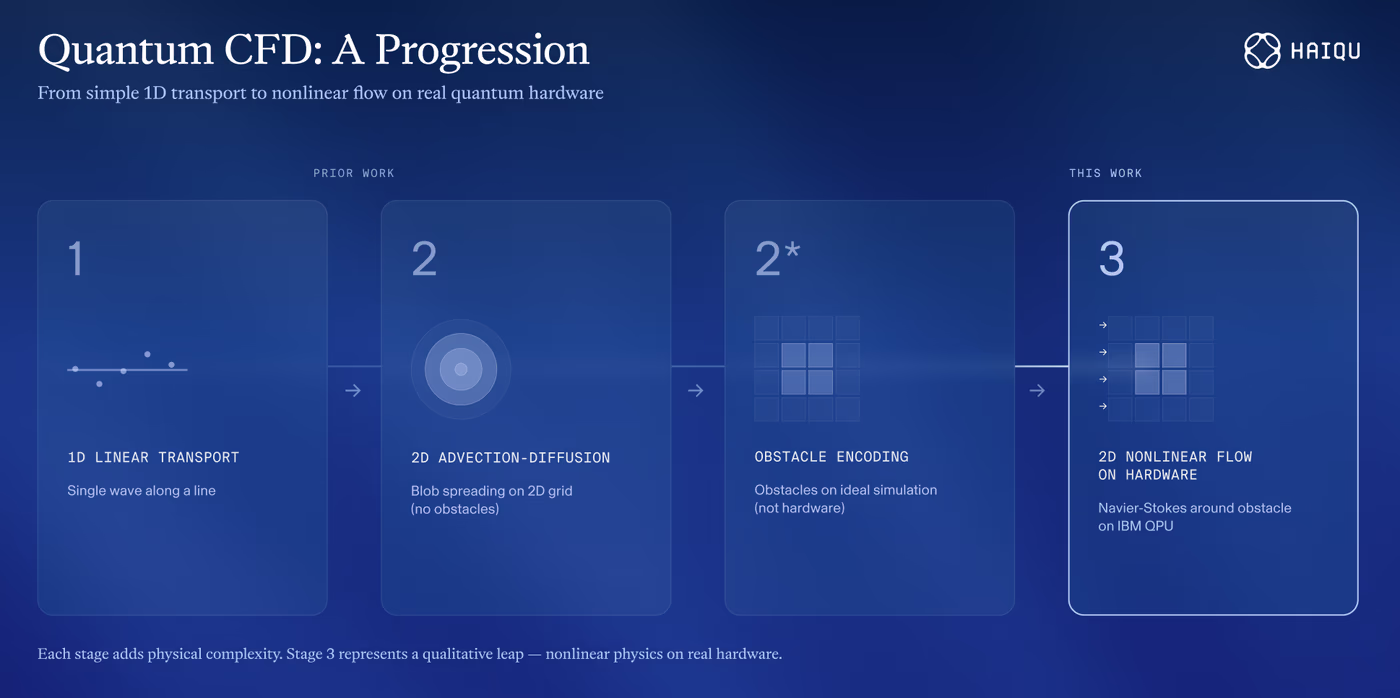
"Progression landscape" from 1D linear transport → 2D advection-diffusion in empty domains → 2D nonlinear flow around an obstacle. 


Why the lattice Boltzmann method suits quantum computing

The lattice Boltzmann method (LBM) models fluid dynamics not by solving the Navier-Stokes equations directly, but by evolving mesoscopic particle distributions on a discrete lattice through two local operations — collision and streaming — from which macroscopic quantities such as fluid pressure and velocity emerge. This structure is already massively parallel on classical hardware; landmark LBM simulations have reached trillions of lattice cells on GPU clusters.

The same structure maps naturally to quantum algorithms, forming the quantum lattice Boltzmann method (QLBM). Streaming becomes a quantum walk. Collision is local and independent of lattice size. And the heavy memory requirements that bottleneck classical LBM become a non-issue when the grid is encoded logarithmically in qubits.

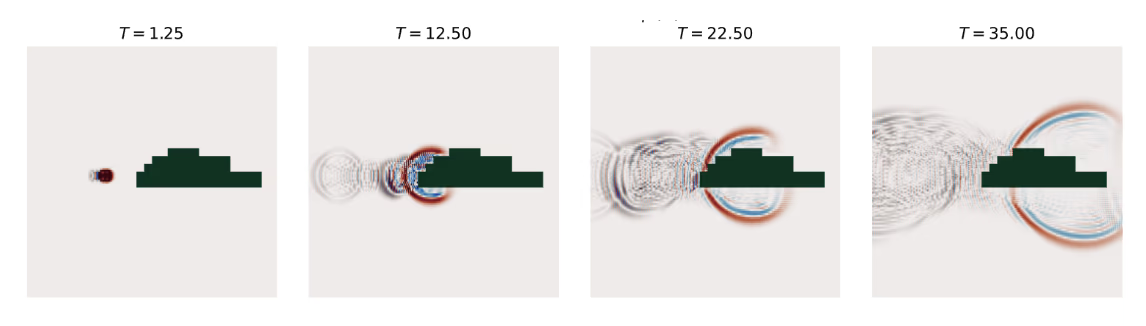
So far, the complete record of QLBM on actual quantum processors — including our own earlier work with Quanscient on IonQ Aria (2024, the largest QLBM grid demonstrated on hardware) — has been limited to linear dynamics on 1D, 2D, and 3D grids. No obstacles. No boundaries beyond periodic conditions. No coupled velocity fields. Each result was an important milestone but the physics that makes real CFD hard was entirely absent from the hardware record.

Until now.


What does this paper demonstrate?

Our joint paper with Quanscient introduces a new quantum algorithm for the lattice Boltzmann method based on the one-step simplified LBM (OSSLBM) and validates it across several cases, culminating in a nonlinear laminar flow benchmark on real quantum hardware.

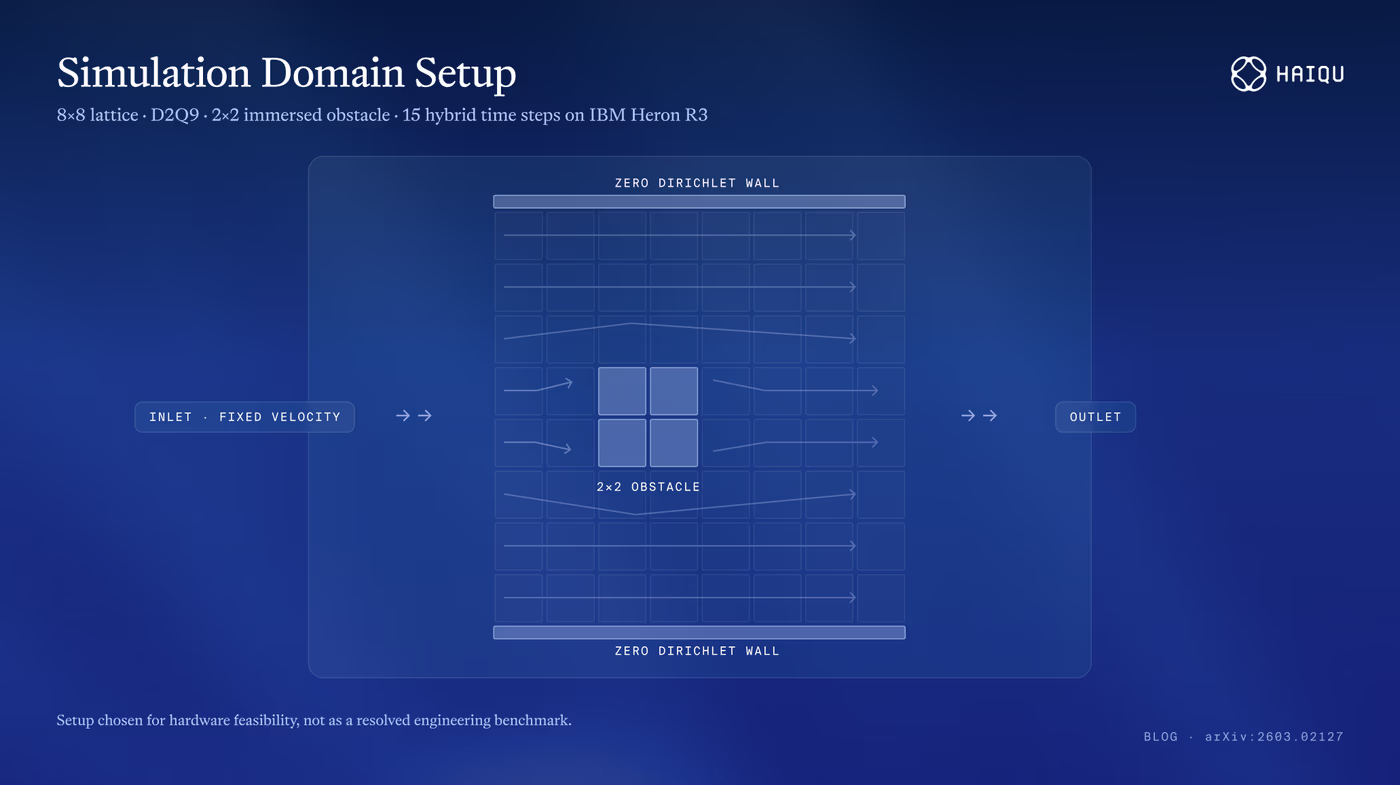
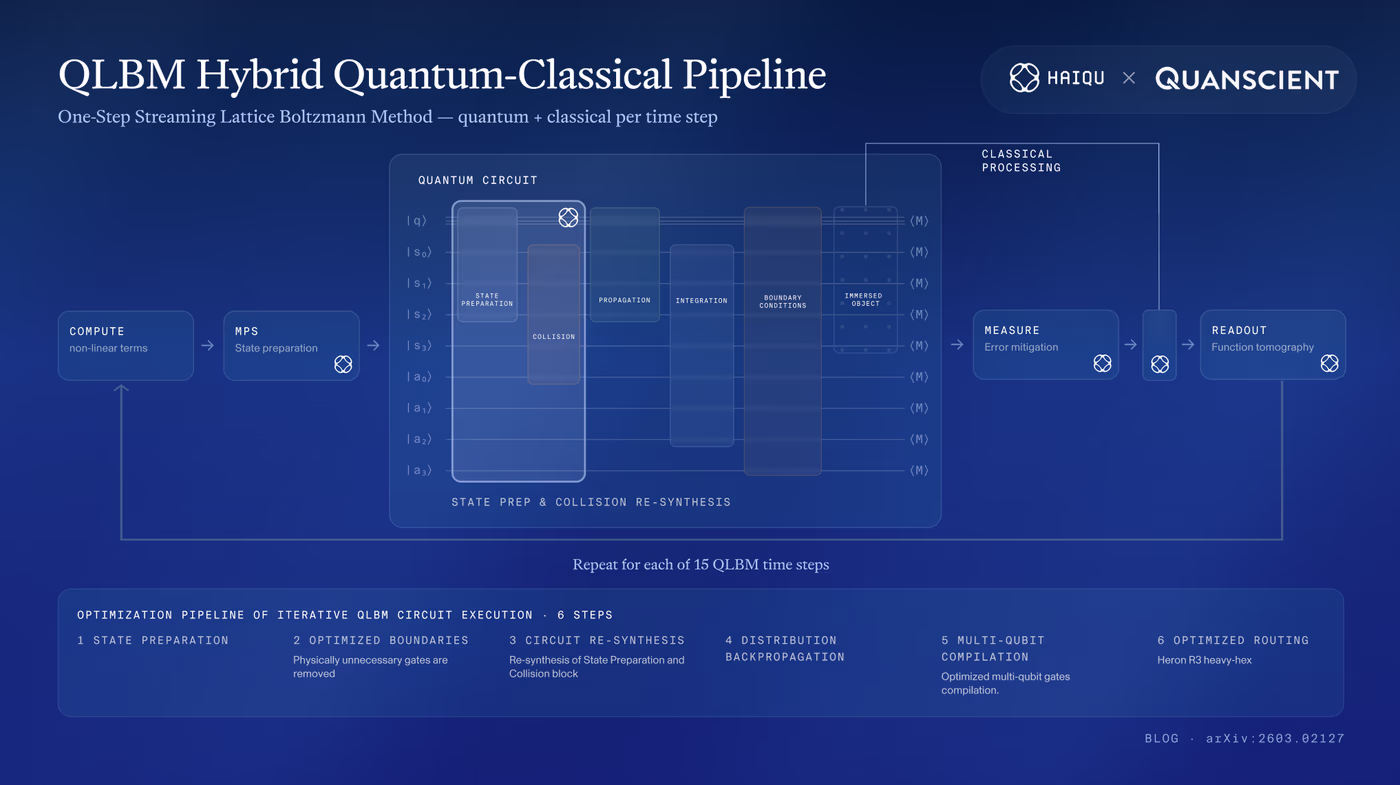
The benchmark: a D2Q9 lattice on an 8×8 grid with a 2×2 immersed square obstacle, inlet-outlet boundary conditions, and zero Dirichlet walls. Flow is driven by a fixed inlet velocity, deflects around the obstacle, and evolves through a 15-step hybrid quantum-classical loop on IBM's ibm_boston processor (Heron R3, 156 qubits).


Domain schematic: 8×8 lattice with 2×2 obstacle
 

Three features distinguish this from all prior QLBM hardware demonstrations.

Nonlinear Navier-Stokes physics. The incompressible Navier-Stokes equations govern the evolution. The nonlinear equilibrium terms are recomputed classically at each step and re-encoded into the quantum state; the quantum processor handles the structured linear update. This hybrid strategy keeps circuits shallow enough for current hardware while accommodating physics that cannot be implemented unitarily.

An immersed obstacle with boundary conditions. No prior QLBM hardware run included any internal geometry. The boundary treatment uses multi-controlled gates that are backpropagated and applied classically to the measured bitstrings — substantially reducing circuit depth.

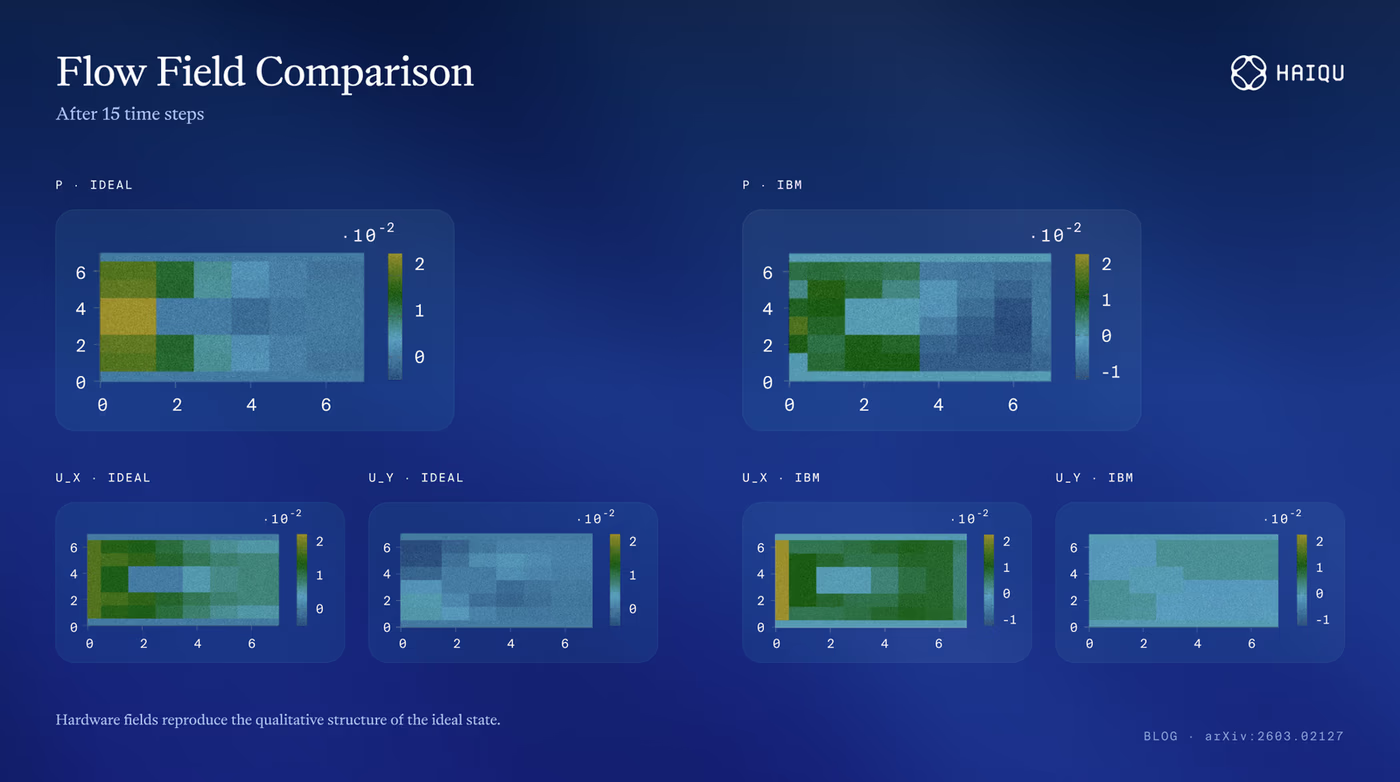
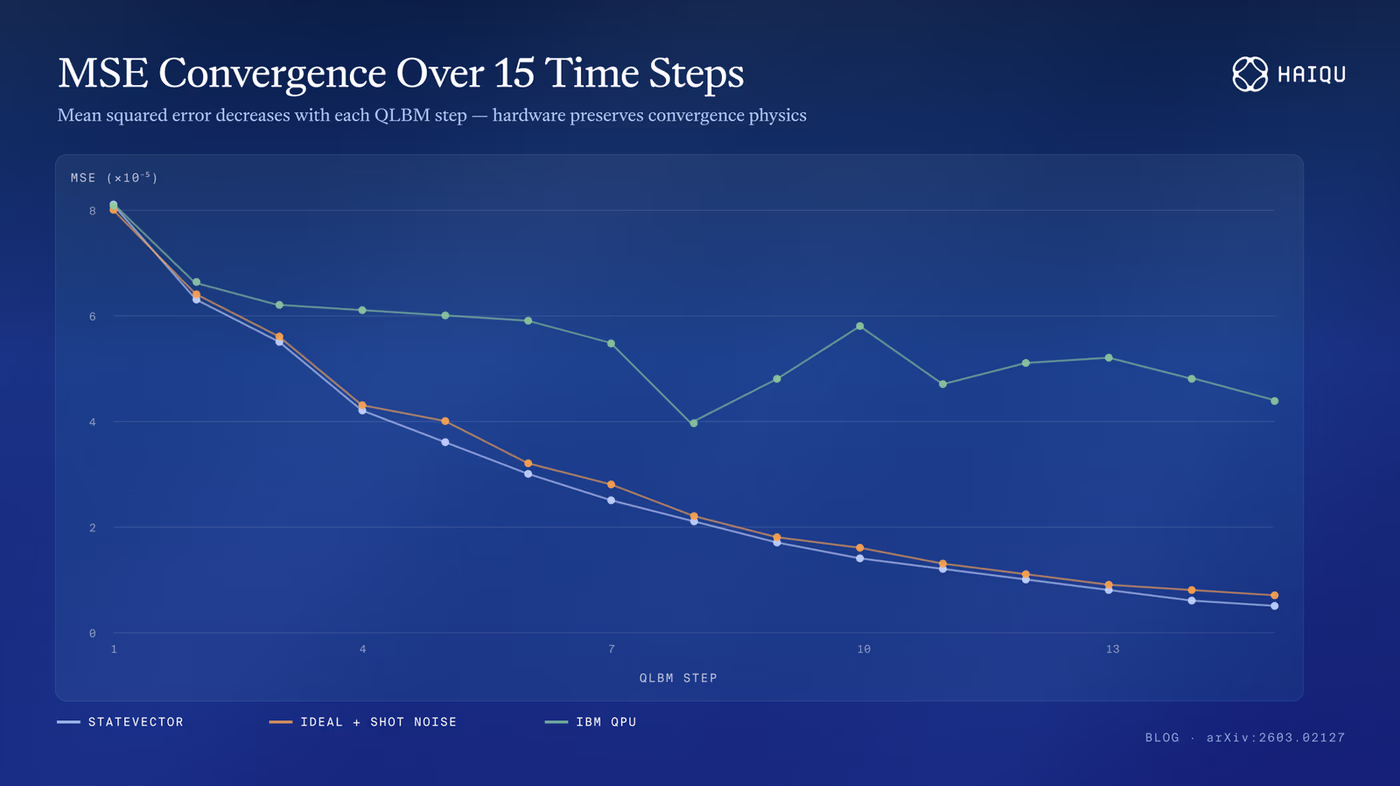
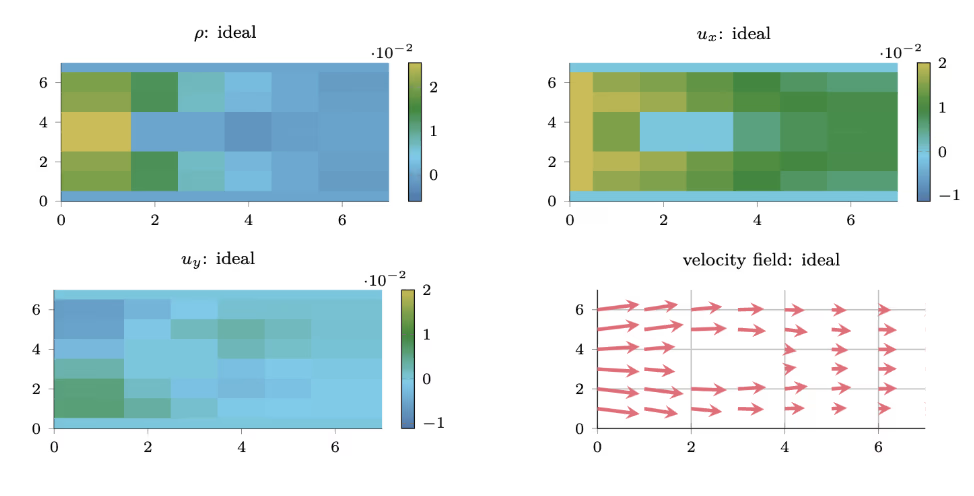
Coupled full-field recovery over 15 time steps. The experiment recovers density and both velocity components (ρ, u_x, u_y) at each step, with the mean squared error relative to a steady-state reference decreasing over the evolution. While a steady state is not reached within the 15 steps executed on the quanutm device, the results show a convergence towards it.


Left: Ideal vs. hardware field maps after 15 time steps for ρ, u_x, u_y Right: MSE convergence plot (statevector, ideal + shot noise, IBM QPU). The IBM QPU execution is noisier but continues to reduce error with subsequent steps — evidence that hardware preserves the convergence physics.


The algorithmic advance: OSSLBM

Our paper's contribution extends beyond the hardware benchmark. Traditional QLBM approaches treat collision and streaming as separate operations on distribution functions. The OSSLBM restructures this into a single-step update operating on macroscopic fields: density, velocity, and pressure, with distribution functions appearing only in the propagation subroutine.

This gives OSSLBM more flexibility to accommodate different physics (acoustics, diffusion, nonlinear Navier-Stokes) within one framework, while keeping the core gate and qubit complexity efficient. For linear problems, it supports multi-step evolution without intermediate measurement — a prerequisite for any future quantum advantage.


Making it run: Haiqu's hardware-enabling stack

A well-designed quantum algorithm is one thing. Getting it to run on hardware is another. Haiqu closed the engineering gap and enabled on-hardware execution thanks to the compilation, state preparation, tomography, and noise-mitigation stack that made the nonlinear obstacle benchmark practical on IBM's superconducting hardware.

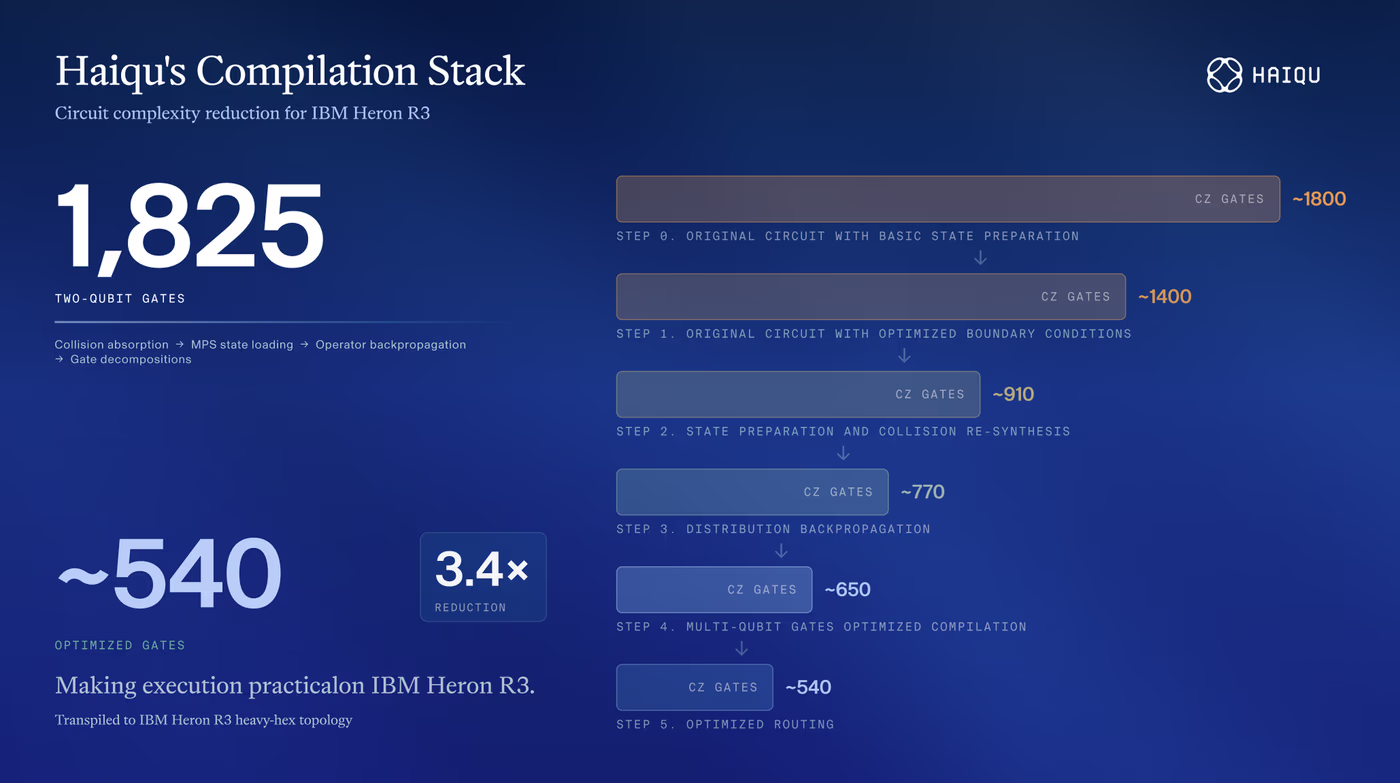
The compilation challenge was substantial. A direct, unoptimized implementation produces approximately 1,825 two-qubit gates after transpilation to the Heron R3 heavy-hex connectivity. This is far beyond what today's error rates allow to execute accurately enough. Haiqu's optimization pipeline brought this down to around 540 two-qubit gates through several coordinated approaches.


Gate-count reduction pipeline
 

Several techniques contributed to the reduction. The QLBM collision step was combined with initial state preparation, strongly compressing the circuit at the cost of only two extra qubits. The state preparation itself was optimized to take advantage of QPU's near-linear qubit layout. Furthermore, commutation of circuit parts implementing boundaries and obstacles with the final measurement was exploited to offload some computation to classical post-processing, shortening the circuit. Finally, all gate sequences were compressed using optimized decompositions of multi-qubit operations.

Noise mitigation was equally important. The execution combined several standard techniques like dynamical decoupling to protect idle qubits, Pauli twirling to symmetrize noise, and operator decoherence renormalization to correct the recovered field norms. With only 3–6% of the 30,000 shots per step surviving post-selection, induced by the QLBM unitary construction, the usable data for field reconstruction was thin. At these margins, every compilation and mitigation choice matters directly.

Finally, recovering full flow fields is required on each step as a part of QLBM’s hybrid pipeline, which is a major bottleneck, since standard tomography has prohibited scaling. We developed a novel variational function tomography method, allowing us to recover near-ideal field values with only a handful of shots. Previous demonstrations were focused on toy examples, where solutions are trivial and known, hence the readout problem did not arise. On the contrary, we demonstrated the most complex readout so far in the quantum CFD, applied to realistic flows.

This is an essential part of a realistic quantum computing workflow. The middleware layer: compilation, transpilation, error mitigation, readout, and runtime orchestration, determines whether a given algorithm produces meaningful results on a given hardware.


Orchestrating that full-stack end-to-end is what Haiqu's platform is built for, and experiments like this one are where it proves its value.


Honest scope: what this does and does not show

This paper demonstrates that QLBM can encode, evolve, and reconstruct a nonlinear Navier-Stokes flow field with an internal obstacle on a real quantum processor, preserving qualitative physics across 15 time steps. That is a material advance over every prior QLBM hardware run.

Whether QLBM can move to deeper end-to-end evolution remains open, depending on both hardware progress and fundamental algorithmic constraints.

The honest framing: this is the most physically complex QLBM simulation run on a real quantum processor in the public record. The advance is in the class of problems, not the immediate scale. The distance between that breakthrough and practical engineering application is still significant. But it is shrinking specifically in the areas where middleware investment pays off: compilation, noise mitigation, and orchestration.


Why should the industry pay attention now?

For R&D leaders in aerospace, automotive, and energy, the significance is strategic rather than operational.

Turbulence alone scales as O(Re³) with the Reynolds number; full-scale aircraft simulations at Re ~ 10⁸ imply roughly 10²⁴ floating-point operations. Quantum computing is one of the very few plausible paths to fundamentally different scaling for these workloads. But that path's credibility depends on the field solving the right kind of problems, not just bigger grids for linear transport.

These results are important because they demonstrate QLBM on real quantum processors, moving toward the very features that make real CFD hard: obstacles, boundaries, coupled fields, and nonlinear dynamics. The grid size is still very small, but the problem difficulty is a qualitative leap.


For organizations evaluating quantum simulation readiness, the practical takeaway is that the gap between a quantum algorithm on paper and a working hardware result is where most efforts stall. Closing that gap requires compilation respecting real device topology, noise mitigation tuned to the application, and runtime orchestration for hybrid loops. That stack is what Haiqu provides, and this paper is a concrete demonstration of its value.


From Haiqu's perspective, the paper validates a thesis we have held from the start: the path to practical quantum scientific computing runs through the execution layer. Better qubits and better algorithms are both necessary but not sufficient. Getting real physics onto real hardware requires an optimization and runtime stack that adapts to the realities of current devices. We will continue building that stack, and we look forward to the experiments it enables next.

The paper "Quantum Algorithm for the Lattice Boltzmann Method with Applications on Real Quantum Devices" by Bastida-Zamora, Budinski, Kerppo, Lahtinen, Niemimäki, Steadman, Zamora-Zamora, Sagaut, Bohun, Koch-Janusz, and Lukin is available at arXiv:2603.02127.

Haiqu Aerospace

Quantum CFD for realistic geometries of obstacles

Blog

From wind-turbine blades to jet engines, unwanted aerodynamic noise reduces efficiency, increases fuel burn, and is subject to regulatory limits. Engineers address these issues using computational fluid dynamics (CFD), which is the numerical solution of partial differential equations (PDEs) on a spatial grid that describes how pressure and velocity evolve in a flowing gas. CFD is everywhere — in aerospace, automotive, energy, climate research, and even consumer-electronics cooling — but it is notoriously expensive. Each increase in spatial resolution dramatically increases both the required memory and the run time. For high-fidelity aero-acoustic simulations, the computational grids easily require billions of points, which challenges even the largest HPC clusters.


Quantum CFD may accelerate these computations exponentially, but encoding realistic geometries while preserving the advantage is a problem in itself. Haiqu researchers have shown how to overcome this challenge for quantum acoustic simulations.
If you're exploring quantum-ready simulations beyond classical HPC limits, Haiqu can help you evaluate what’s possible today and what’s coming next.

Book a demo


The Quantum Leap

Quantum computers offer a potential breakthrough: since the entire spatial grid can be encoded with logarithmically many qubits and the PDE simulated in time polynomial in qubit numbers, an exponential advantage over classical CFD simulations could be achieved!


One of the recent approaches to solving the PDE itself is by mapping it to a quantum system evolving under a Hamiltonian, which can very naturally be simulated on a quantum computer. However, in order to apply to realistic problems, such as sound scattering from an aircraft wing, the appropriate fluid equations and boundary conditions that describe arbitrary geometries and obstacles must  be included in the quantum Hamiltonian, which is highly nontrivial.

This is precisely the problem that the Haiqu researchers addressed in their work, “Quantum Hamiltonian simulation of linearised Euler equations in complex geometries”. They showed how classical CFD equations for sound propagation can be directly mapped to a quantum computation, particularly when including complex obstacles (like wings!), in a way which preserves the exponential advantage of the quantum approach.


Turning Everyday Air Flow into a Quantum Algorithm

The air particles behave according to three simple bookkeeping rules: mass is never lost, momentum changes only when forces act, and energy has to go somewhere (it cannot appear or vanish). Writing those ideas down for every tiny parcel of air gives a system of linked equations—one for each rule—so that changes in pressure, density, and velocity stay consistent everywhere in the flow. For real-world viscous fluids, these equations are the famous Navier–Stokes equations.

To simplify the problem, we use the approximation that air is an inviscid fluid (no stickiness) and does not exchange heat. Under those two assumptions, the Navier–Stokes equations collapse into the much simpler Euler equations. Imagine now a smooth and uniform background flow of a fluid - picture a steady breeze moving in a single direction. The sound waves we care about are tiny ripples on top of that steady breeze, and we can therefore linearise the Euler equations: keep only the terms that describe these small disturbances and drop all higher-order contributions.

The linearised Euler (LE) equations so obtained (here: in two dimensions) describe how pressure and fluid velocity components evolve while being carried downstream by the uniform flow with speed u in x direction:
 

Above, u,v,p denote, respectively, the velocities in the x,y directions and the pressure deviation from the average, while is the density of the environment, and c is the speed of the sound.

As sound is a pressure wave, the LE equations model the propagation of noise through the air. In the absence of background flow (u=0) they reduce to a simple wave equation.


While approaches for solving the simpler wave equation on a quantum computer have been shown, until now, this was not the case for more complex linearized Euler equations. One of the ways quantum computers can be used to solve such classical problems is by looking at them as a kind of quantum evolution — that is, interpreting them as describing how a quantum system changes over time.


We can generally write our classical PDE system as df/dt=Af with f=(p,u,v), for a linear operator A. Interestingly, when A has certain properties — in particular, when it is made up of real numbers and is antisymmetric — we can rewrite this problem in a way that looks just like how quantum systems evolve. In quantum physics, the evolution of a system over time is described by the Schrödinger equation df/dt=-iHf, which depends on the Hamiltonian operator H. You can think of the Hamiltonian as the "energy operator", it prescribes how the system behaves, controlling its evolution. If we can rewrite our classical problem in terms of a Hamiltonian — by formally setting H=iA (where i is the square root of -1) — then solving the original problem becomes like simulating a quantum system over time. As Hamiltonian operators obey certain mathematical properties (hermiticity), such rewriting is only sometimes possible, and depends on the details not only of the equation, but also of the boundary conditions, all of which determine the structure of the matrix A.

Haiqu researchers have shown how this can be achieved for the linearized Euler equations, even when arbitrarily complex boundary conditions, describing obstacles such as wings, pipes, constructions etc. are included. This allows modeling aero-acoustic phenomena in realistic scenarios. Since the ultimate goal is the simulations of these systems on real quantum devices, an important contribution of the work is the detailed construction of explicit quantum circuits, which can be executed on typical QPU architectures, for example superconducting devices. 

Figure 1 - Ideal quantum simulation of the quantum circuits derived by Haiqu for the 2D pressure wave propagation on a constant background flow in the x direction with an impenetrable obstacle (colored in darkgreen). One can observe how the wave, starting from a single point source, propagates and moves with the flow, bending the object and reflecting from it.


💡 What makes this work special is that these complex boundary conditions, key to solving realistic problems, are shown to be implementable without breaking the simulation’s efficiency.

That is, including obstacles in the flow does not lead to an asymptotically higher computational cost or increase the simulation error.


From Research to Real Quantum CFD

Haiqu researchers have developed a novel quantum algorithm for simulating the linearized Euler equations. The approach demonstrates a clear potential for quantum advantage by leveraging exponential grid encoding with only polynomial quantum resources, and allows to construct simulations of real-world aero-acoustic problems, thanks to an efficient implementation of complex obstacles and boundary conditions in the equation.


Move from insight to execution. See how Haiqu turns quantum CFD research into runnable workflows on today’s quantum hardware.

Talk to the Haiqu team


Download our research paper for more information.

Interested in more Quantum CFD research? Explore the AWS blog post about our work with Quanscient on running the largest-grid Quantum CFD simulation on a real QPU, as finalists in the Airbus & BMW quantum challenge.

Haiqu News 07

Haiqu raises $11M seed round led by Primary

Blog

Haiqu keeps the party going. 

Thank you to our new investors: Primary Venture Partners, Collaborative Fund, Alumni Ventures, Qudit Ventures, Silicon Roundabout Ventures, Harlow Capital, and Hyperion Capital. 

Thank you to our returning investors: MaC Venture Capital & Toyota Ventures.

Thank you to our champions across the industry.

Now Phase II begins: our Product phase.

Don't be a classicist. Try our beta. 

Read the full press release here.

Haiqu News 08

Haiqu claims advance in fraud detection technology

Blog

Quantum software startup Haiqu announced results from a trial this week demonstrating that current quantum computers could detect subtle financial anomalies that could indicate fraud more efficiently than purely classical systems.

The research, which used a hybrid computing approach pairing quantum processing power with traditional machine learning models, revealed performance gains that suggest a near-term path toward achieving "quantum advantage" for large-scale, real-world problems.

Read full article here.

Haiqu News 06

Haiqu and HSBC research team encodes ‘largest financial distributions to date’ on quantum computers

Blog

A team of Haiqu-led researchers have developed a new approach to encoding complex financial data into quantum circuits, pushing the limits of IBM’s quantum processors, according to a paper published on the pre-print server arXiv. The team reports that the method, which focuses on shallow and efficient circuit designs, could advance the use of quantum computing in finance and other industries.

In a recent LinkedIn post on the paper, the team writes: “Quantum computing cannot achieve wide utility in the near term until we can efficiently load classical data onto quantum hardware. Now, we can.”

Read full article here.

Haiqu News 05

Haiqu recognized by Sifted as an emerging top quantum computing startup

Blog

Sifted asked investors in the field who they think is the next big thing in quantum computing.

European quantum startups are on the rise. Last year, while many VC-backed companies in the region were struggling to raise funds, Europe’s quantum startups actually saw investments grow by 3% to reach $781m — more than three times the amount raised in the sector in North America ($240m).

It also made Europe the only region to see funding for quantum startups increase, while investments in North America dropped by 80%, and by 17% in Asia-Pacific.

With strong support from governments — the UK has committed $4.3bn to quantum technologies, while Germany has pledged over $3.7bn — and burgeoning interest from VCs, Europe’s quantum scene is growing steadily. 

Read full article here.

Haiqu News 03

Haiqu and Perimeter Institute forge new model for quantum computing research

Blog

The Perimeter Institute has established a new partnership with quantum software startup Haiqu (pronounced as ˈhaɪku) that will bring fundamental research and technological innovation closer together. Haiqu has established operations in the US, UK, and Ukraine. Through this partnership, the company will base its first Canadian hire, Dmitri Iouchtchenko, at the Perimeter Institute Quantum Intelligence Lab (PIQuIL).

Read full article here. 

Haiqu News 02

Haiqu presents at Creative Destruction Lab’s super session as top graduating venture

Blog

Graduating Ventures Took to the Main Stage at Super Session, Sharing Their CDL Journeys

Founders and speakers representing four graduating ventures and three CDL alumni companies got onstage in front of a thousand of their peers, mentors and investors to share their inspiring stories of success, and reflect on their takeaways from the CDL program.

The concluding main stage event at June’s Super Session was a showcase of some of the incredible talent that’s recently been nurtured within the 24 global streams that make up the Creative Destruction Lab (CDL) program...Another venture invited to the main stage was quantum computing company Haiqu. Unlike other streams, applicants being considered for fall admission into the Quantum program travel to Toronto for several weeks between July and August for a bootcamp. That’s where this graduating company’s co-founders, Richard Givhan and Mykola Maksymenko, met last year.

Read full article here.

Haiqu News 01

Haiqu Raises $4M Pre-Seed to Boost Quantum Computing Adoption

Blog

Haiqu Raises $4 Million in Pre-Seed Funding to Boost Adoption of Near-term Quantum Computing

Haiqu, a startup building software to enhance the performance of quantum processors, today announced it has closed a $4 million financing round led by MaC Venture Capital, with participation from Toyota Ventures, SOMA capital, u.ventures, SID Venture Partners and Roosh Ventures. The round also included private contributions from Paul Holland, Alexi Kirilenko and Gordy Holterman.

“We are accelerating the timeline to practical quantum computing by developing novel software that can extract value out of clumsy near-term quantum hardware, enabling quantum applications that were previously impossible.” said Richard Givhan, co-founder and CEO at Haiqu. “We are proud to be backed by investors with remarkable deep-tech ecosystems and a track record of supporting the commercialization of breakthrough tech.“

Read full article here.

Read Banner

Quantum embeddings for anomaly detection

Blog
Overview

Detecting rare or unusual patterns requires working with large, complex data.

Traditional machine learning loses accuracy when data has many features but few examples.

Quantum machine learning can uncover patterns classical methods miss, but is limited by low qubit counts to low-dimensional datasets.

Haiqu’s new quantum encoding solution packs hundreds of features into just a few qubits and scales efficiently, removing a major barrier to real-world data processing on a quantum computer.

Anomalies are the world’s early warning systems. They appear as subtle ripples before an earthquake, a sudden deviation in a patient’s vital signs, or a single fraudulent transaction hidden among millions of legitimate ones. Detecting such rare events is essential for safety, trust, and reliability in modern data-driven systems. Still, it remains one of the hardest problems in machine learning.

The reason lies in their rarity. By definition, anomalies are statistical outliers, making up only a fraction of a dataset. Classical models must learn to recognize these events despite being trained predominantly on normal examples. And in practice, the data itself compounds the difficulty. Hundreds of correlated features, nonlinear dependencies, and limited examples make it hard for algorithms to find meaningful structure.

Classical approaches like decision trees, logistic regression, and deep neural networks have achieved remarkable progress, but even the best of them eventually plateau. Particularly at high dimensionality and low sample size, they begin to lose their footing. This is where quantum computing, with its fundamentally different way of representing and processing information, may offer a new path forward.

“The ability to encode high dimensional data with hundreds and even thousands of features enables applications of a new scale, as what the team at Haiqu has experimentally shown on our hardware. Advances like this are what push the industry towards achieving a quantum advantage in the near term.”
 

Jay Gambetta, Director of IBM Research

Where Classical Representations Fall Short


Machine learning is dependent upon how we represent data. The features describing the data determine what a model can perceive, and, as a result, what it can learn. The goal of kernel methods and, more broadly, of representation learning is to construct new data features, often by embedding in larger spaces, which “expose” the inherent patterns in the data1. This allows downstream machine learning models to achieve better performance in e.g. classification tasks. In most real-world data, however, the relations between these features are nonlinear and strongly correlated, which poses a major challenge to classical methods.

Quantum systems, by contrast, naturally take advantage of superposition and entanglement to process unstructured feature vectors2. This allows both to embed data in an exponentially larger space of multi-qubit states and to reveal its structure through the use of quantum dynamics, enabling efficient classification. In other words, mapping classical data into this space effectively expands the representational canvas and allows the discovery of patterns that classical embeddings may flatten or miss entirely.

This concept is central to quantum machine learning. Through quantum embeddings, data is transformed into quantum states, and similarities between samples are evaluated via quantum kernels, comparable to kernel methods in classical machine learning but powered by the physics of interference. Even when run in simulation, these quantum representations reveal how computation in Hilbert space can enrich classical preprocessing2.

"Understanding and implementing quantum embedding is an essential part of data analysis on quantum devices. Ultimately, they define the complexity of models and their performance. [...] Anomaly detection is a very suitable target, since even a smaller improvement in scores can lead to crucial detections or elimination of false positives."

Prof. Oleksandr Kyriienko
Professor and Chair in Quantum Technologies at the University of Sheffield.

Encoding Data of Previously Impossible Size


The first step to constructing a quantum embedding is to encode the original data in a quantum state, which is then transformed using e.g. quantum dynamics. While many existing studies rely on angular encodings, such methods quickly reach their limits as the number of qubits required grows linearly with the number of data features 3, 4. Most near-term quantum devices have fewer than 150 qubits, yet anomaly-detection and other real-life datasets can easily contain hundreds or thousands of features. This creates a dimensionality gap that makes naïve quantum feature maps impractical.

The Problem

Near-term quantum devices have fewer than 150 qubits, making naïve feature encodings impractical for real-world datasets with hundreds or thousands of features.

To address this challenge, we developed a novel data encoding method, which allows us to encode polynomially more features with the same number of qubits. Moreover, our method awards control over the complexity of the resulting quantum state and of the quantum circuit creating it. This permits adjusting the embedding to both the number of features in the data, as well as to the parameters of the QPU. Our dataset contained 506 classical features which we mapped onto 128 qubits, but the same QPU could be used to encode an order of magnitude larger feature numbers with our technique.

The Solution

We develop an encoding solution that allows an order of magnitude more features to be loaded on a QPU.

The resulting embeddings can be used as feature transformations in any machine-learning pipeline, feeding quantum-enriched data into classical models. This hybrid structure of classical models trained on quantum-preprocessed data forms the foundation of our experiment.

“Haiqu’s scalable embedding technology marks a turning point for quantum machine learning, making complex, high-dimensional data practical at scale. This innovation doesn’t just advance research; it accelerates the shift toward real-world impact in industries like finance, where precision and insight redefine what’s possible.”

Dr. Kristin Milchanowski, Chief AI and Data Officer, BMO

A Head-to-Head Comparison


To test the performance of our quantum embeddings against their classical counterparts task we designed an experiment with two parallel pipelines: a hybrid one (quantum+classical), and a fully classical one, as shown in Figure 1. The inputs to both are constructed from the Multivariate Time Series Anomaly benchmark used to evaluate the detection of rare events in temporal data. Our dataset consists of a smaller and balanced subset of 250 samples of coarse-grained time-series, where time-points within time windows in the original data have been merged together to form high-dimensional vectors of 506 features.

This reduced sample size enables easy reproducibility of our experiments—including the costly QPU runs—while still capturing the complexity of real-world scenarios.

Fairness of comparison was central to our evaluation of the potential of quantum embeddings. In both pipelines, data is embedded into an enlarged space. In the quantum setting, we apply our novel data encoding, evolve the system under a parameterized quantum circuit implementing Heisenberg dynamics with randomly chosen parameters, and measure the resulting state to obtain new classical features. This is a form of projected quantum kernel (PQK) [3, 4]. In the classical pipeline, we tested two forms of embeddings with the same number of parameters as the quantum model: neural networks with random parameters, and random Fourier features. These embeddings produced new classical features of the same dimensionality as those generated by the quantum feature map.

Both the quantum-processed and classically-generated features were then input into the same families of classical classifiers, such as random forests and logistic regression. The hyperparameters of each classifier were independently optimized to ensure the best possible performance within each pipeline. We employed an 80/20 train–test split and evaluated performance using the F1 score, which balances precision and recall for imbalanced classification tasks.


Figure 1: Quantum versus classical embeddings experiment pipeline. Both process the same dataset, but use different feature construction methods before feeding it into classical classifiers. The input data has 506 features per data point (see the main text for details). The quantum embedding uses Haiqu's proprietary data loading to encode each point in a quantum state over 128 qubits, which is then transformed through an evolution circuit with random parameters, and, finally, read out with 1024 measurement shots. These measurements are used to compute the expectation values of 8256 observables. On the classical side, random neural networks and random Fourier Features are used to construct features, also of 8256 dimensions. Classical classifiers (see Fig.2) are then trained separately for the classical and quantum features (we selected the best quantum, and the best classical features) and their performance compared.

Results: Quantum-Enhanced Preprocessing Works

The results show a consistent trend: quantum-preprocessed features outperform classical ones across multiple models. Crucially, this is the case both in simulation and on real QPUs.

In ideal simulations, our projected quantum kernel (PQK) achieved an F1 score of 0.98, outperforming classical baselines of around 0.90–0.93. Even on real quantum hardware, in this case an IBM Quantum Heron processor, where noise and gate infidelity introduce imperfections, the model retained an impressive 0.96 F1, showing that the method is both effective and robust under realistic device conditions.


Figure 2. Top: The F1 score of different classical classifiers using either the classical (black) or the quantum (blue) features obtained on the IBM Quantum Heron processor. For most classifiers the quantum features provide better performance. Bottom: A more detailed comparison for the Logistic Regression Classifier. The classifier with original input data achieves an F1 score of 0.91, while the random classical embeddings essentially do not improve the score (0.92). In contrast, using the random quantum embedding a score of 0.98 is obtained when simulated without noise, and 0.96 when executed on the real noisy quantum processor.

The largest relative improvements appeared in tree-based models such as Decision Trees and Random Forests, which benefited most from the richer feature representations. Across the board, these results suggest that quantum embeddings can serve as a general-purpose preprocessing layer, improving performance without changing model complexity or parameter count. In other words, quantum systems need not replace classical models, but augment them.

A Glimpse of the Future
 

The importance of our findings is threefold:

— First, it shows that quantum-enhanced features can achieve superior performance over classical embeddings in complex data.

— Second, that extremely high-dimensional data can be embedded using our methods on existing QPUs.

— Third, we show that this superior performance is present both in idealized simulation that validates the pipeline, and on real noisy quantum hardware.

Taken together, the results provide an empirical signal that quantum advantage with QML may be possible to achieve in full-fledged industrial deployment to complex high-dimensional problems, and that investigating efficient quantum data embeddings on real datasets is a promising path towards realizing that advantage.

This holds even without training the embedding weights, which should further improve the features, and thus the final performance.

Importantly, while our experiment scale still allowed for a classical simulation to validate the results, its complexity was already such that sampling on the QPU was actually faster than running the classical simulations. 

With increasing problem size (and thus qubit numbers and circuit depth) classical simulations will become completely infeasible, but already at smaller scales it may become advantageous to use the QPU at least for the inference from a trained kernel.

Thus, a hybrid QML pipeline which achieves superior performance in a complete end-to-end industrial deployment will likely involve a classical pre-training step of the quantum embedding using large scale simulation, followed by an optional fine-tuning step on a QPU, and finally, an inference step performed at test time on a QPU.

This hybrid workflow could extend beyond anomaly detection into fields like cybersecurity, financial modeling, predictive maintenance, and health diagnostics, all domains where interpretability and early warning signals matter most.

A Call To Explore
 

Our anomaly-detection study provides early evidence that quantum-enhanced preprocessing is practically meaningful even on today’s noisy hardware. Out study demonstrates how hybrid pipelines can achieve measurable gains without increasing model complexity, parameter count, or data requirements.

We are now preparing to share interactive notebooks that allow verified beta users to reproduce this experiment using Haiqu’s embedding technology. These tools will enable researchers and developers to explore quantum preprocessing within their own domains, from time-series analysis to computer vision, and benchmark their results against classical baselines.

We invite the community to join this exploration: replicate, challenge, and build upon our results. Each successful reproduction strengthens the case for a future where quantum and classical computation work hand in hand, and where models understand data more deeply. 

Footnotes

  1. Shawe-Taylor, John, and Nello Cristianini. Kernel methods for pattern analysis. Cambridge university press, 2004.
  2. Schuld, Maria, and Francesco Petruccione. Machine learning with quantum computers. Vol. 676. Berlin: Springer, 2021.
  3. Schnabel, J., and M. Roth. "Quantum kernel methods under scrutiny: A benchmarking study (2024)." arXiv preprint arXiv:2409.04406.
  4. D'Amore, Francesco, Luca Mariani, Carlo Mastroianni, Francesco Plastina, Luca Salatino, Jacopo Settino, and Andrea Vinci. "Assessing Projected Quantum Kernels for the Classification of IoT Data." arXiv preprint arXiv:2505.14593 (2025).
Chladni still

Reducing quantum and classical resources for quantum-centric supercomputing workloads on near-term hardware

Publications

We study analytically and experimentally the performance of Sample-based Krylov Quantum Diagonalization, on current noisy quantum computers. We show that noise imposes strong constraints on the convergence of the algorithm, but that Haiqu’s compression tool allows one to recover the theoretical convergence guarantee in real experiments. We demonstrate this on a 40-qubit experiment by recovering the ground state of the Anderson impurity model, a paradigmatic example of strongly-correlated systems, using IBM quantum computers.

Date: 15 September 2026
Journal/conference link and reference: Paper link not yet available.
QCE26 Workshop on Advancing Hybrid Computing Through Shared Challenges in 2026 IEEE International Conference on Quantum computing and Engineering (QCE’26)

Chladni still

What Symmetry Buys on Hardware: Compressing an SU(2)-Equivariant Ansatz for the Kagome Heisenberg Antiferromagnet

Publications

Working with researchers at the Perimeter Institute, we asked what a quantum circuit's built-in symmetry is actually worth on today's noisy hardware, rather than on paper. Exploiting the rotational symmetry of a frustrated magnet, we cut a trained circuit's most expensive gates by nearly three quarters, turned the symmetry into a free filter against measurement noise, and reached excited states by re-initialising the same circuit. We then ran it on an IBM processor. Pushing demanding condensed-matter problems inside the limits of the machines that exist today is how quantum computers start doing useful science before full fault tolerance arrives. 


Date: 13 September 2026
Journal/conference link and reference: Paper link not yet available.
4th International Workshop on Quantum Machine Learning,  in 2026 IEEE International Conference on Quantum computing and Engineering (QCE’26)
 

Chladni still

Solving Virtual Backbone Problems with Digitized Cyclic Annealing on Near-Term Quantum Computers

Publications

Current quantum computers are limited in the number of operations they can execute, which can limit the performance of certain algorithms such as the Quantum Approximate Optimization Algorithm (QAOA). We show that we can circumvent this limitation by iteratively improving the quality of the solutions we obtained from a depth-limited QAOA circuit by using insights from the phase diagrams of the related spin system. We apply this Cyclic annealing technique to identify the virtual backbone of a unit-disk graph, a problem encountered in network design and antenna placement.

Date: 31 July 2026
Journal/conference link and reference: Published in 2026 35th International Conference on Computer Communications and Networks (ICCCN) 
DOI : 10.1109/ICCCN69946.2026.11662952 
 

Chladni still

Entanglement scaling in matrix product state representation of smooth functions and their shallow quantum circuit approximations

Publications

We show how using Haiqu’s Tensor Network tools extremely shallow and accurate quantum circuits encoding data such as probability distributions can be prepared for large qubit numbers. Such circuits are required in quantum finance applications, where naive data loading may ruin any chance of quantum advantage. In our work we analyse theoretical properties of such encodings and demonstrate our algorithm loading the largest to-date examples of financial distributions on up to 156 qubits.

Date: 20 April 2026 
Journal/conference link and reference: Phys. Rev. Research 8, 023062 (2026)
https://journals.aps.org/prresearch/abstract/10.1103/yyvr-dtsb


Read on arXiv 

Chladni still

Quantum algorithm for the lattice Boltzmann method with applications on real quantum devices

Publications

In collaboration with Quanscient, Haiqu demonstrated the first non-linear simulation of 2D Navier-Stokes (NS) equations with obstacles on an IBM quantum processor. This is an important milestone, as this quantum computational fluid dynamics (CFD) problem exhibits all the key features of real industrial applications, such as calculating the airflow around an airplane wing, that is both the presence of non-linearities and complex boundary conditions. 

Date: 2 March 2026
Journal/conference link and reference: N/A

Read on arXiv 

Chladni still

Quantum Hamiltonian simulation of linearised Euler equations in complex geometries

Publications

We extended a promising quantum algorithm for solving partial differential equations (PDE), key to modelling fluid, heat, and radiation flows in industrial and scientific applications, to a much broader and realistic class of systems. In particular we showed how to efficiently include obstacles, representing e.g. aircraft wings, or fluid nozzles, in the algorithm, without compromising the potential quantum advantage. We demonstrated the method by generating and executing quantum circuits for a simulation of acoustic wave propagation.

Date: 20 October 2025
Journal/conference link and reference: N/A

Read on arXiv 

Chladni still

Computational access to lattice and long-wavelength physics in quantum mutual information

Publications

Quantities like Quantum Mutual or Renyi Information are important in studying quantum systems, but are very difficult to experimentally or numerically evaluate. We investigate the computational and theoretical properties of many of their variants, identifying preferred ones, which are the least sensitive to physically unimportant simulation details.

Date: 2 October 2025
Journal/conference link and reference: N/A


Read on arXiv 

Chladni still

Accelerating Transpilation in Quantum Machine Learning with Haiqu’s Rivet-transpiler

Publications

Quantum programs need to be translated into hardware-compatible instructions before they can run, a process known as transpilation. In applications such as quantum machine learning, circuits may change repeatedly during training, normally requiring them to be transpiled again after each modification; Haiqu’s Rivet transpiler avoids much of this repeated work by reusing already-translated parts of the circuit. In our experiments, this reduced transpilation time by up to 6x, enabling faster iteration and making larger, more complex quantum models more practical to train.

Date: 29/08/2025
Journal/conference link and reference: N/A


Read on arXiv 

Chladni still

Beyond Penrose tensor diagrams with the ZX calculus: Applications to quantum computing, quantum machine learning, condensed matter physics, and quantum gravity

Publications

Working with researchers at Quantinuum, the Universities of Oxford and Cambridge, and the Perimeter Institute, we introduced Spin-ZX, a graphical language for reasoning about quantum systems with spin. By making complex spin structure easier to represent, manipulate, and connect to quantum circuits, the framework expands the tools available for designing and analysing more expressive quantum algorithms, setting the stage for new capabilities in quantum computing and quantum machine learning.

Date: 08/11/2025
Journal/conference link and reference: N/A
 

Read on arXiv 

Chladni still

A graphical diagnostic of topological order using ZX calculus

Publications

Working with researchers at the CNRS and the Donostia International Physics Center, we developed a graphical way to identify topological order using ZX calculus, without relying on traditional entanglement-entropy calculations. Understanding and diagnosing these robust forms of quantum order is an important step toward controlling complex quantum systems, helping develop the foundations for fault-tolerant quantum computation and the quantum resources needed for useful computation.

Date: 15/01/2025
Journal/conference link and reference: N/A

Read on arXiv 

Chladni still

Machine Learning the Operator Content of the Critical Self-Dual Ising-Higgs Gauge Model

Publications

We combine AI with information theoretic tools to discover the physical theory underlying an important condensed matter model. Lattice gauge theories such as the Self-Dual Ising Higgs gauge model are central to current research on phase transitions in strongly interacting systems and materials, and are also important in high-energy physics. 

Date: 25 December 2024
Journal/conference link and reference: Phys. Rev. Research 6, 043322 (2024)
https://journals.aps.org/prresearch/abstract/10.1103/PhysRevResearch.6.043322


Read on arXiv 

Chladni still

Efficient Hamiltonian Simulation: A Utility Scale Perspective for Covalent Inhibitor Reactivity Prediction

Publications

We demonstrate how Haiqu’s optimized execution enables the dynamical simulation of the electronic structure of pharmaceutically-relevant molecules. Previously unavailable due to extremely deep quantum circuits being corrupted by the hardware noise, these results, in combination with classical machine learning, enable prediction of reactivity of the studied molecules. This property is a key metric in drug discovery research. Following a 15x reduction of the quantum circuit depth compared to baseline, we recovered the relevant signal from the quantum computer with high accuracy, while the bare execution produced uniform noise.

Date: 2024/12/20
Journal/conference link and reference: Accepted to Royal Society’s Phil. Trans. A., as part of a bigger paper. 


Read on arXiv 

Chladni still

Compression theory for inhomogeneous systems

Publications

We show how graph-based machine learning (ML) combined with information theory tools allows to automatically build and discover the properties of complex physical systems with irregular structure, such as quasicrystals. This is very important as many real materials, such as glasses, lack any regular crystalline structure.

Date: 25 November 2024
Journal/conference link and reference: Nature Communications 15, 10214 (2024)


Read on arXiv 

Chladni still

Efficient Training of Layerwise-Commuting PQCs with Parallel Gradient Estimation

Publications

Training variational quantum algorithms is normally expensive because each step requires repeated measurements on the quantum device to find the gradient. There exists a shortcut to bypass this cost, but it only works for circuits that are too simple to be useful. By building up and training the circuit one layer at a time, we keep the power of more expressive circuits while still cutting the number of measurements needed.

Date: 15 September 2024
Journal/conference link and reference: 2024 IEEE International Conference on Quantum Computing and Engineering (QCE’24) https://ieeexplore.ieee.org/document/10821191
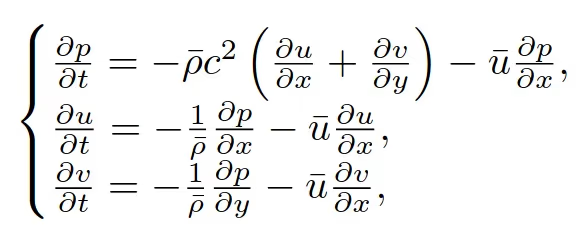


Chladni still

Distributed Quantum Dynamics on Near-Term Quantum Processors

Publications

Quantum simulations of dynamics, key to materials science, are hindered both by limitations of qubit numbers and executable circuit depth. Here we combine two distinct methods alleviating each of them separately. By combining quantum circuit cutting with projected Variational Quantum Dynamics we are able to execute a deeper and wider quantum circuit, distributed across two separated quantum processors, than would have otherwise been possible.

Date: 5 Feb 2024
Journal/conference link and reference: N/A. 

Read on arXiv 

Chladni still

Approaching Quantum Utility by Leveraging Quantum Software Stack

Publications

This paper examines how software can help improve the practical performance of quantum computers and accelerate progress toward useful quantum computing.

It focuses on quantum middleware: the software layer between high-level quantum algorithms and the underlying hardware. This layer can optimize circuits, map computations onto physical qubits, reduce the impact of noise and errors, and provide more direct control over how quantum programs are compiled and executed.

The paper introduces the concept of Quantum Computing Optimization Middleware (QCOM) as a reference architecture for combining these capabilities in a structured way. It reviews optimization opportunities across different parts of the software stack, including circuit simplification, qubit mapping and routing, error suppression and mitigation, and lower-level machine instructions.

It also discusses tools such as Qiskit, Q#, and OpenQASM that can be used to experiment with these approaches. The main argument is that advances in middleware can significantly expand what can be achieved with existing quantum hardware, while also providing a foundation for more capable quantum systems in the future.

Date: 26 September 2023
Journal/conference link and reference: 2023 IEEE 13th International Conference on Electronics and Information Technologies (ELIT) https://ieeexplore.ieee.org/document/10310743