Reducing quantum and classical resources for quantum-centric supercomputing workloads on near-term hardware
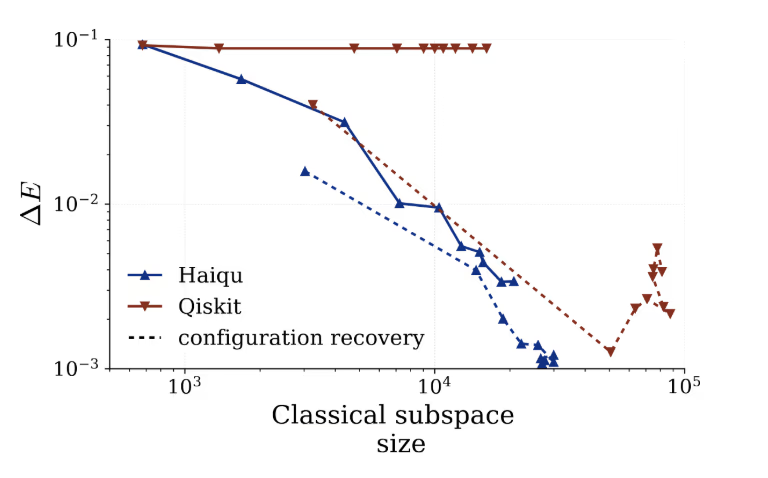
We study analytically and experimentally the performance of Sample-based Krylov Quantum Diagonalization, on current noisy quantum computers. We show that noise imposes strong constraints on the convergence of the algorithm, but that Haiqu’s compression tool allows one to recover the theoretical convergence guarantee in real experiments. We demonstrate this on a 40-qubit experiment by recovering the ground state of the Anderson impurity model, a paradigmatic example of strongly-correlated systems, using IBM quantum computers.
Date: 15 September 2026
Journal/conference link and reference: Paper link not yet available.
QCE26 Workshop on Advancing Hybrid Computing Through Shared Challenges in 2026 IEEE International Conference on Quantum computing and Engineering (QCE’26)